Showing posts with label social mobilization. Show all posts

Thursday, March 28, 2013

Free medical consultations for communities in Thiès, Senegal

Story by Courtney Petersen, Photos by Jo-Anne McArthur

“My head is aching, and the rest of my body has been in pain for a couple of years,” Mame Ndingue told the visiting medical team in Senegal. Because of her pain she is unable to tend to her normal responsibilities, and, like many others in her rural community, she cannot afford medical treatment. 


From March 19 - 29, Tostan is collaborating with the Mary A. Tidlund Charitable Foundation to increase access to healthcare through free medical consultations in rural communities in the region of Thiès, Senegal. The medical team includes two doctors, five nurses, and three volunteers from Canada along with a team of Tostan staff and volunteers acting as translators. 

The Senegal medical team and translators 
holding Tostan health and human rights posters.
The medical team is working together with the Head Doctor of the region and local nurses at the health posts in Saam Njaay and Tassette to host free health consultations to community members like Mame Ndingue. These communities built their understanding of health as a human right through participation in our Community Empowerment Program (CEP) or through community-organized social mobilization activities. Through the CEP and activities community members learn the importance of consulting a doctor when they are ill.

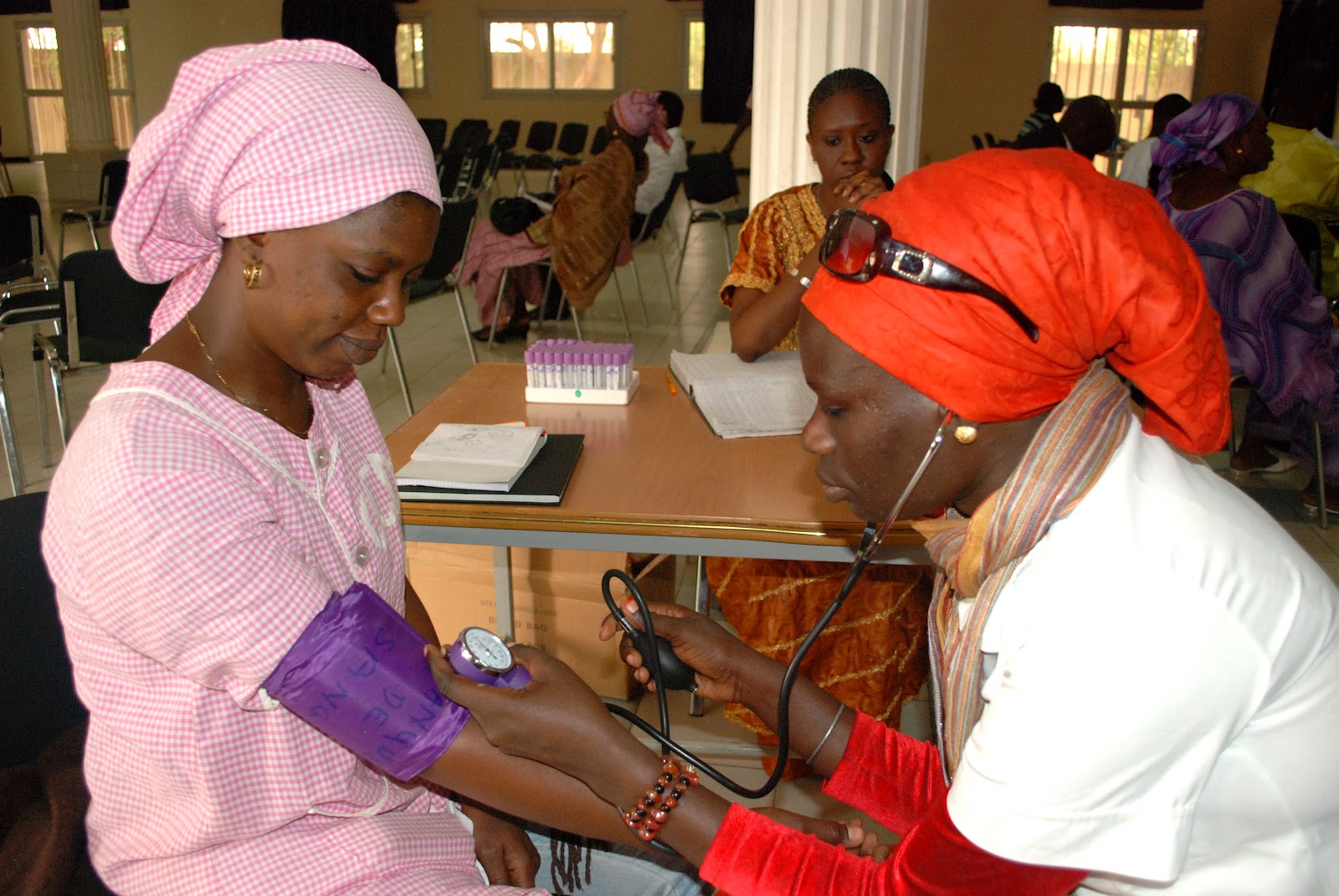
Each day the nurses register patients, record their medical concerns and history, and make a basic health assessment. The doctors then sit with each patient to consult them on their main health concern and give a medical exam. This continues all day until every patient has the opportunity to be consulted.
 

One of the doctors at the consultations, Dr. Gulshan Lodhy, shared that the most common illnesses being treated are ear, eye, and respiratory tract infections, as well as chronic illnesses such as hypertension, diabetes, and muscle and bone pain.

For many patients who attended the free consultations, seeking regular medical attention is not an option because of the high cost of medication and treatment, especially for chronic illnesses. The free consultations provide much needed access to affordable healthcare in the region.

Mame Ndingue shared how important this health consultation was to her: “[The consultation] was very good because I am not paying for anything. Usually, I don’t have enough money to go to the doctor so I am very happy to have had this opportunity.”


So far 380 patients have received medical care through the free consultations.

Monday, March 4, 2013

Portrait of a Leader: Yama Bathia

A few years ago, Yama Bathia experienced gender-based violence in her own home.  Since that day, she has worked hard to create a safe space for problem solving in her community of Bougnadou Manjaque and to challenge harmful social norms, such as female genital cutting (FGC). On a recent visit to Bougnadou Manjaque in the Sédhiou region of Senegal, Tostan Social Mobilization Agents (SMAs) spoke to Yama personally about her experience with violence and how that has shaped her perspective of FGC. Yama agreed to share her story in hopes of raising awareness about gender-based violence and educating others on the harmful consequences of FGC.

Yama: One day during winter, after the rains came, I was cultivating rice in a field five kilometers from our village. I left my infant daughter with my husband while I worked in the fields. There was so much work that day - the work was hard - and I had to walk all the way back. So I arrived home late, around 7:00 pm. My daughter was crying because she was hungry and had not eaten since before I left. I went outside to wash before feeding my daughter when my husband found me, and he was very angry. He hit me several times but my family heard and was able to intervene and stop him.

A few hours later I was still very upset, but asked my family to help organize a meeting between my husband and me. I first spoke to my husband, and he explained that he was angry at me for leaving our daughter without anyone to breastfeed her. I told my husband I was sorry, but that in the future we should discuss our problems respectfully. If we can’t resolve them, we should ask for help from someone in the village but violence can never be a solution. 

SMA: What happened after this incident occurred? Has there been any violence in your community since then? 

Yama: After this my husband apologized, and it has never happened again. We talked about violence, especially against women and girls, in a large community meeting. We all agreed that violence is never acceptable and that we would try to make a space where people can go to discuss and resolve their problems. Sometimes they talk to their family, an imam, or the local village council, and sometimes we talk together as a community. I don’t think any other women have experienced violence since then. Our village is small so everyone knew what happened to me, and I think it changed the way people address conflict. It made people realize that violence is never a good solution and that violence against women is something we cannot accept.
A Tostan meeting in Yama's village of Bougnadou Manjaque.
SMA: How does this relate to FGC? Do you see that practice as a type of violence? 

Yama: Yes. After the incident with my husband we talked more about violence in our community, and I thought a lot about violence against women. I realized that FGC is a type of violence, especially against girls. They do not consent to undergo this practice, and they have no choice in being cut. I know this practice is very old, it is not a part of Islam, and we see now that it causes serious health consequences. We had some health problems in our village with girls who were cut before, but we ignored them for a long time. Since our community has started talking about violence, especially violence against women, it has been easier to discuss FGC. Also, as we participate in Tostan classes, we’ve really started to understand how FGC is a violation of human rights and how it blocks our development. Our village has decided to abandon the practice completely, and I hope that other villages will follow. 

SMA: What would you say to others who practice FGC? 

Yama: I would tell them that this practice causes a lot of problems for women and girls, some very serious and sometimes even deadly. I would tell them that FGC is a form of violence against women and girls and that it violates our human rights. I would tell them that we must stop this practice together so we can improve our health, develop our community, and live more in peace.

Photographs by Angela Rowe, Tostan.


Monday, January 28, 2013

The Social Mobilization Team of Sédhiou, Senegal plans to make an impact on FGC abandonment in their region

Article by Angie Rowe, Tostan Volunteer in Kolda, Senegal


What is the key to mobilizing entire social networks around the promotion of human rights? The answer is to utilize the greatest and most effective advocates for positive change: passionate community members themselves, social mobilization agents. 
Social mobilization is organized information-sharing through awareness-raising campaigns and activities.  In villages who are participating in Tostan’s Community Empowerment Program (CEP), teams of social mobilization agents are created to extend the reach of knowledge shared in CEP classes. This ensures that entire networks of people are informed and feel a part of any decision to promote positive social change in their area. Social mobilization teams also organize inter-village meetings to discuss important issues and achieve consensus on decisions affecting the extended social network.
As part of our continuing partnership with Orchid Project, two social mobilization teams were created in Kolda and Sédhiou in southern Senegal to lead awareness-raising activities that will engage neighboring communities around human rights and accelerate the movement for female genital cutting (FGC) abandonment in regions where rates are the highest. Read more about this social mobilization project in a great article on Orchid Project's blog. 
Each team consists of a supervisor and five social mobilization agents specifically selected for their skills in communication and their dedication to positive social change. We introduced Kolda’s social mobilization team last week, and now we are glad to introduce to you the social mobilization team of Sédhiou, Senegal! 

Abdoulaye Kebe, Supervisor, Sédhiou

Abdoulaye works for Tostan because he strongly believes in the promotion of human rights and the preservation of human dignity. Excited to be a part of this new project, he hopes to use his previous experience with social mobilization activities to support positive behavioral change in villages throughout Sédhiou. Outside of work Abdoulaye enjoys reading the Koran and tending his garden.  

Mariama Doumboya, Social Mobilization Agency (SMA), Sédhiou
In the past, Mariama worked for Tostan as a Community Empowerment Program (CEP) facilitator in Sédhiou, where she focused specifically on social mobilization activities. She continues to work with Tostan to increase her knowledge of human rights and health and share that knowledge with communities. In her free time, Mariama loves to cook—especially dishes with couscous. 
Mamadou Sao, SMA, Sédhio
Mamadou was born and raised in Sédhiou and is very passionate about improving the well-being of people in his region. He is particularly interested in helping to bring an end to violence against women and children. He hopes that as a member of the social mobilization team he can provide information to villagers, encouraging them to abandon harmful practices such as female genital cutting (FGC), child/forced marriage, and early pregnancy. Outside of work he enjoys playing soccer, scrabble, and reading.
 
Seydi Bouba, SMA, Sédhiou
Seydi is an advocate for education rights and enjoys working for Tostan as its program makes nonformal education accessible to community members. He is interested in working with Orchid Project because its goal aligns closely with something he is passionate about: the abandonment of FGC. He hopes to use his skills to inform people of the harmful consequences of FGC and child/forced marriage throughout the duration of this project. Outside of work he enjoys farming and other agricultural activities.  
Mouskeba Konte, SMA, Sédhiou
Born in Sédhiou, Mouskeba has always felt passionate about health issues in her community. She was happy to find work that supported her beliefs and hopes that the work of Tostan will further develop her country positively. She is excited to be part of the social mobilization team where she can use her knowledge and experience to prompt meaningful discussion in local communities.  She hopes this work will eventually lead to total abandonment of FGC in Senegal. Although Mouskeba is kept busy as a member of the social mobilization team, she always makes time outside of work to spend with her children.
Bamba Lylla Marena, SMA, Sédhiou
Bamba believes that education and literacy are key components of sustainable development, and he enjoys working with Tostan in its efforts to accomplish these goals. He believes that child/forced marriage and FGC pose serious and significant health problems and hinder the development of Senegal in general. He believes that total FGC abandonment is both necessary and possible. When not working, Bamba enjoys playing the piano and socializing with friends.

The above portraits are based on short interviews that were held on an informal, respectful, and voluntary basis in the participants’ own language with the assistance of an interpreter.

Monday, January 21, 2013

Social Mobilization Agents play key role in the movement for FGC abandonment in Kolda, Senegal


Article by Angie Rowe, Tostan Volunteer in Kolda, Senegal
What is the key to mobilizing entire social networks around the promotion of human rights? The answer is to utilize the greatest and most effective advocates for positive change: passionate community members themselves, social mobilization agents. 
Social mobilization is organized information-sharing through awareness-raising campaigns and activities.  In villages who are participating in Tostan’s Community Empowerment Program (CEP), teams of social mobilization agents are created to extend the reach of knowledge shared in CEP classes. This ensures that entire networks of people are informed and feel a part of any decision to promote positive social change in their area. Social mobilization teams also organize inter-village meetings to discuss important issues and achieve consensus on decisions affecting the extended social network.
As part of our continuing partnership with Orchid Project, two social mobilization teams were created in Kolda and Sédhiou in southern Senegal to lead awareness-raising activities that will engage neighboring communities around human rights and accelerate the movement for female genital cutting (FGC) abandonment in regions where rates are the highest. Read more about this social mobilization project in a great article on Orchid Project's blog.  
Each team consists of a supervisor and five social mobilization agents specifically selected for their skills in communication and their dedication to positive social change. This week we’re introducing you to the social mobilization team of Kolda and check our blog next week for the social mobilization team of Sédhiou!
The social mobilization team of Kolda working together to plan upcoming social mobilization activities in the region.
Thierno Yaayaa, Supervisor, Kolda

Thierno has been working for Tostan for nearly ten years, and is extremely experienced in social mobilization activities. One of his key areas is health, particularly in remote rural villages where access to healthcare is limited. His work with Orchid Project is a continuation of years of passionate service in the effort to help communities abandon harmful practices that hinder positive social change in Senegal. When he is not busy working with communities, Thierno likes to farm and occasionally works as a local merchant.

Fatoumata Balde, Social Mobilization Agent (SMA), Kolda
Born and raised in Kolda, Fatoumata enjoys creating positive change in local communities. She believes her work with Tostan is necessary and will aid the development of impoverished communities and decrease the rate of violence against women and children. As a social mobilization agent, she hopes to use her passion and her beliefs to promote FGC abandonment throughout Kolda. When not working, Fatoumata sells goods at the local market.
Lamarana Balde, SMA, Kolda
Lamarana is a Koranic scholar who enjoys working for Tostan because he believes that community participation is important to the development of his region. He hopes that the social mobilization teams are able to deliver important and accurate information to local villages, and in doing so, encourage them to abandon practices that are harmful to their health and development as a community. When not working with Tostan, Lamarana does agricultural work and teaches children in his village.
Moussa Diallo, SMA, Kolda
Moussa is a Marabout (religious teacher) in his village in Kolda. He works with Tostan because he is passionate about local health, youth education, and democracy. Moussa believes that complete abandonment of FGC is necessary to achieve progress throughout Senegal. When he is not working with Tostan he teaches the Koran to youth in his community.
Fatoumata Binta Balde, SMA, Kolda
Fatoumata believes that working with Tostan is extremely important, and she is dedicated to addressing the issues faced by young women and girls, specifically those related to child/forced marriage and FGC. She is particularly keen to share important knowledge about health with communities.  When not at work, Fatoumata enjoys cooking and finding new ingredients at the local markets.
Keloutang Diao, SMA, Kolda
Keloutang was born in Kolda and has seen the importance of good health in his village firsthand. He works with Tostan to fulfill important health needs in local communities that he believes are critical for development. Being a member of the social mobilization team, gives him the ability to directly participate in the development of his country. Outside of work he enjoys tending his garden and working with livestock.
The above portraits are based on short interviews that were held on an informal, respectful, and voluntary basis in the participants’ own language, with the assistance of an interpreter.


Wednesday, September 19, 2012

MDG3 in Action: Health and Human Rights


In support of the Global Festival, we will post a story each week during the month of September featuring Tostan's commitment to Millennium Development Goal 3 (MDG3), 'Promoting Gender Equality and Empowering Women' in the series MDG3 in Action.

Join us in the movement to end extreme poverty by becoming a Global Citizen. Watch, view, and share stories on the Global Citizen website to earn tickets to the Global Festival!

Leading Health and Human Rights Initiatives in Sahre Bookar

Story by Anna Vanderkooy, Tostan Projects Assistant, Senegal
Ramatou and her daughter Miriama

Mamadou Ramatou Diallo (Ramatou) lives in Sahre Bookar, Senegal. She is the Coordinator of the Health Commission of Sahre Bookar’s Community Management Committee (CMC). Sahre Bookar formed a CMC when it began Tostan’s Community Empowerment Program in 2010. Composed of up to six commissions (health, environment, child protection, education, income-generating activities, and social mobilisation), the CMC is a 17-member democratically-selected group that organizes awareness-raising events and leads development projects designed by the community. A minimum of nine of the members are women.

In 2011, inspired by the knowledge of health risks and human rights violations gained in Tostan's Community Empowerment Program (CEP), her community of Sahre Bookar held a village-wide meeting to discuss the abandonment of FGC and child/forced marriage. Consensus was reached, as community members confirmed that these two practices harmed the well-being of girls and women in the community. 

Now, as the head of her community's Health Commission, Ramatou is confident that all girls in the community, including her 13-year old daughter Miriama, will benefit greatly from this new respect of their rights. Girls were formerly married as young as 13 to men of their parents' choosing, but today they are assured the right to remain in school and to choose their own husbands after the age of 18. 

Through the Health Commission, Ramatou has organized a number of awareness-raising campaigns in the community related to vaccinations, malaria, and risk reduction during pregnancy. She has seen changes since the arrival of the program, citing that all villagers now sleep under mosquito nets, parents now respect the vaccination calendars set out by the local health post, and expectant mothers attend pre- and post-natal consultations, giving birth at local health centers instead of at home. 

Ramatou also started a health fund, with everyone in the village contributing 100 CFA ($0.25) three times a year. This fund supports health initiatives in the community, giving loans to villagers to assist them in the payment of hospital fees and transportation to appropriate facilities. Next year she hopes to use money from this fund, along with support from the local health post, to start a health closet that will ensure access to basic medication in Sahre Bookar.

With her knowledge and skills gained from the Tostan program, Ramatou has been empowered to play a leadership role in her region of Senegal, striving for better health and well-being for Sahre Bookar and surrounding communities. 

Tuesday, March 27, 2012

Video: Hosting a Blood Drive and Honoring Tostan Retirees in Thiès, Senegal

Previously, Alisa Hamilton, our communications assistant in Dakar, Senegal,  shared with you two photo essays: one on a Tostan blood drive and the other on a Tostan retirement ceremony. Both events took place on February 17th, 2012 at the Centre de Capacitation pour le Developpement Durable (CCDD) in Thiès, Senegal. Below is video Alisa made of that day:

Friday, March 2, 2012

Tostan Hosts a Much-Needed Blood Drive in Thiès, Senegal

Story by Alisa Hamilton, Tostan Communications Assistant, Dakar, Senegal

In Senegal, only .25% of the population regularly donates blood compared to the average 2% of donors in other countries. As a result, the National Blood Drive Center in Senegal consistently experiences blood supply shortages, therefore limiting the number of essential blood transfusions that can be performed. Blood banks, like the one in Thiès, Senegal, rely primarily on word of mouth to mobilize potential donors in the community.

On Friday, February 17, Tostan team members rallied their social networks and hosted a blood drive at Tostan’s Training Center for Sustainable Development (Centre de Capacitation pour le Developpement Durable, CCDD) in Thiès, Senegal. On that day, 50 community members and Tostan employees made the decision to help save lives by donating their blood.  

Check out pictures from the blood drive below:

__________________________________________________________________


Aminata Saho, a Tostan team member at the CCDD, has her blood pressure taken. She and her friend and colleague, Ndiaye Aminata Puit, learned about the blood drive that day and both decided to donate for the first time.

**
Ardo Fall, Director of the CCDD, watches as his donation bag fills. He has given blood for four years and often travels to the hospital to give for emergency cases. When asked why he gives blood, Ardo responded, “Because it saves lives. It’s something that I respect because some day, it might be me who needs it.”

**
Smiling, Aminata stays calm during her first blood donation. She shared that she wanted to donate because giving blood can help people who are sick, such as her mother who recently received a blood transfusion. 

**
Khady Diato Sall, the donation organizer at the blood bank in Thiès, Senegal has given blood over 50 times. “[Donating blood] is a civic act,” Khady explained. “Many people don’t do it because they are afraid or they think it won’t help. But every day the hospital calls us for donations. It saves lives.”

**
Ousamane Cisso used to be afraid to give blood, but has since overcome his fear and encouraged many of his friends to donate as well. His mother works for the blood bank, and Ousamane and many of his relatives came to the CCDD to donate on the day of the blood drive.

**
Mohamed Sall (far left), Ousamane Cisso’s cousin, came to give blood for the first time. He used to be afraid of needles, but Ousamane encouraged him to overcome his fear. “I know the hospitals suffer from a lack of blood. I wanted to help people because it can save a life,” explained Mohamed. Here he poses with his friends.

**
The Cisso family after giving blood. From left to right: Ismael Cisso, Allasane Cisso, Mamie Cisso, Aliou Cisso, Boubacar Cisso.

**
Ndiaye Aminata Puit (right) poses with her friend, Sorde, after donating for the first time. 

** 
Khady Guèye (left), Treasurer of the Federation of Community Management Committees (CMC) in the region of Thiès, and Khady Mbaye Ka (right), President of the Thiès CMC Federationalso gave blood for the first time. Khady Mbaye explained, “Giving blood is a noble act. A way to manufacture blood has not yet been invented so we will always need donations.” She continued that many women, including one of her sisters, need blood transfusions during childbirth due to haemorrhaging.


Tuesday, February 14, 2012

RH Reality Check Highlights Tostan's Respectful Approach to FGC


RH Reality Check, an online community and publication site dedicated to promoting sexual and reproductive health and rights, recently highlighted Tostan's successful grassroots approach to promoting the abandonment of female genital cutting (FGC). The article drew attention to Tostan's subtle but important use of nonjudgmental language in discussing FGC as a means to respecting a community's agency to affect social change as well as the role the media can play in supporting such efforts. Read an excerpt from the article below or read the original full article at RH Reality Check's website here. 
***


Yesterday was International Day of Zero Tolerance to Female Genital Mutilation (FGM), a UN-sponsored day dedicated to raising awareness of the thousands year-old practice whereby a girl or woman’s genitals are cut. The WHO estimates that about 140 million women worldwide are currently living with the consequences of FGM. It’s considered by many to be harmful to a woman’s health and rights, as consent is rarely involved and the procedure is rarely done in hygienic settings.

The practice is often described in the most cringe-worthy and heart string-pulling ways (think legs tied down, shards of glass cutting at a young girl’s genitals, for example) and has roots that are centuries old and spread round the world. The act is not religiously based – though it’s often (mistakenly) attributed to or equated with Islam – but rather based in historical cultural concepts of women’s worth and value.

Continue reading the full article
here.

Monday, January 16, 2012

Portrait of a Leader: Mbamata "Fatou" Jawneh


‘‘When I meet with a challenge that is when I have more courage to continue...’’
Mbamata Jawneh is a leader. Individual by individual, village by village, Mbamata is working towards a Gambia free of female genital cutting (FGC) and other harmful traditional practices. Mbamata is quick to express gratitude for the knowledge and skills she learned in Tostan’s human rights-based Community Empowerment Program (CEP), but it is clear that beyond her education, she also possesses a natural ability to lead. She has the tact, perseverance, and patience necessary to engage individuals in discussions about sensitive issues. These qualities have led her to achieve great things in her community, specifically to take a leading role in organizing social mobilization activities. 
Mbamata was elected as Lady President of her community, Mane Kunda–a predominantly Mandinka suburb of the town of Basse in the Upper River Region (URR) of The Gambia. Her dynamism in this role made her an obvious candidate for the role of Community Management Committee (CMC) Coordinator, and when Tostan began implementation of the CEP in 2007, she was elected to the position. With the support of her colleagues and community, Mbamata facilitated a birth registration campaign, which registered over 360 children for birth certificates; she organized weekly cleaning activities, which got members to sweep clean the community of trash, animal droppings, and standing water; and she coordinated fundraising events and women’s discussion groups. Within a short time, Mbamata demonstrated to her community that she is an active and formidable proponent for change in Mane Kunda. 
Possibly most notable, though, is Mbamata’s commitment to share the knowledge she has gained with her community and thereby live the Mandinka saying, ‘karang kabarra,’ meaning ‘practice what you know.’ In doing this, Mbamata also holds true to Tostan’s fundamental goal: to train communities with the skills necessary to lead locally-driven change. 
It was this drive that led Mbamata to form the first social mobilization team in The Gambia. Mbamata recognized the need to systematically engage interconnected villages in discussions about key topics, such as FGC. This process of information-sharing throughout social networks is what Tostan calls organized diffusion. Inspired by her passion to bring about the complete abandonment of FGC, Mbamata formed a group of nine committed individuals who meet and discuss important social and health issues with community members throughout their village’s established social network. 
Speaking candidly during one of her team’s visits to a neighboring community, Mbamata explained, ‘‘FGC should be abandoned because all the motives that lead us to practice it are not achieved. It does not prevent girls from being sexually active. It is not associated with Islam and it brings huge health complications.’’ 
In their efforts, Mbamata’s team began by approaching 25 communities and then expanded their reach to include an additional 40 neighboring villages. She is now the Social Mobilization Coordinator for three teams in the URR: a Mandinka, a Fula, and a Serahule mobilization team, each of which specialize in outreach to their respective ethnic groups.
“We approach communities with patience and we listen and speak to them,” said Mbamata in explaining her approach. “When there is resistance, we encourage individuals from the community who are supportive to speak to those who are opposed to what we have to say. The change comes from within.’’ 
Thanks to Mbamata and her teams’ efforts, a public declaration for the abandonment of FGC and child/forced marriage was held in June 2011. With over 1,800 participants from 117 communities in attendance, the event marked a huge success in the movement for positive social change. Mbamata is proud of her teams’ achievements, but is continually looking for ways to help her community progress even further. ‘‘We need to motivate,” she says, “with motivation many things [can] happen in the future.’’ 
Ever the optimist, when one of Mbamata’s teams meets with resistance in a community, she remembers what it is that inspired her to start the work in the first place: ‘‘a desire to see the future of the nation prosper...better health and better education will make a better Gambia.’’


Photos by Elizabeth Loveday, Tostan Regional Volunteer in The Gambia

 
Blog adapted by Salim Drame