Showing posts with label Kolda. Show all posts

Thursday, February 28, 2013

NEW PHOTOS: Public Declaration in Fafacourou, Senegal

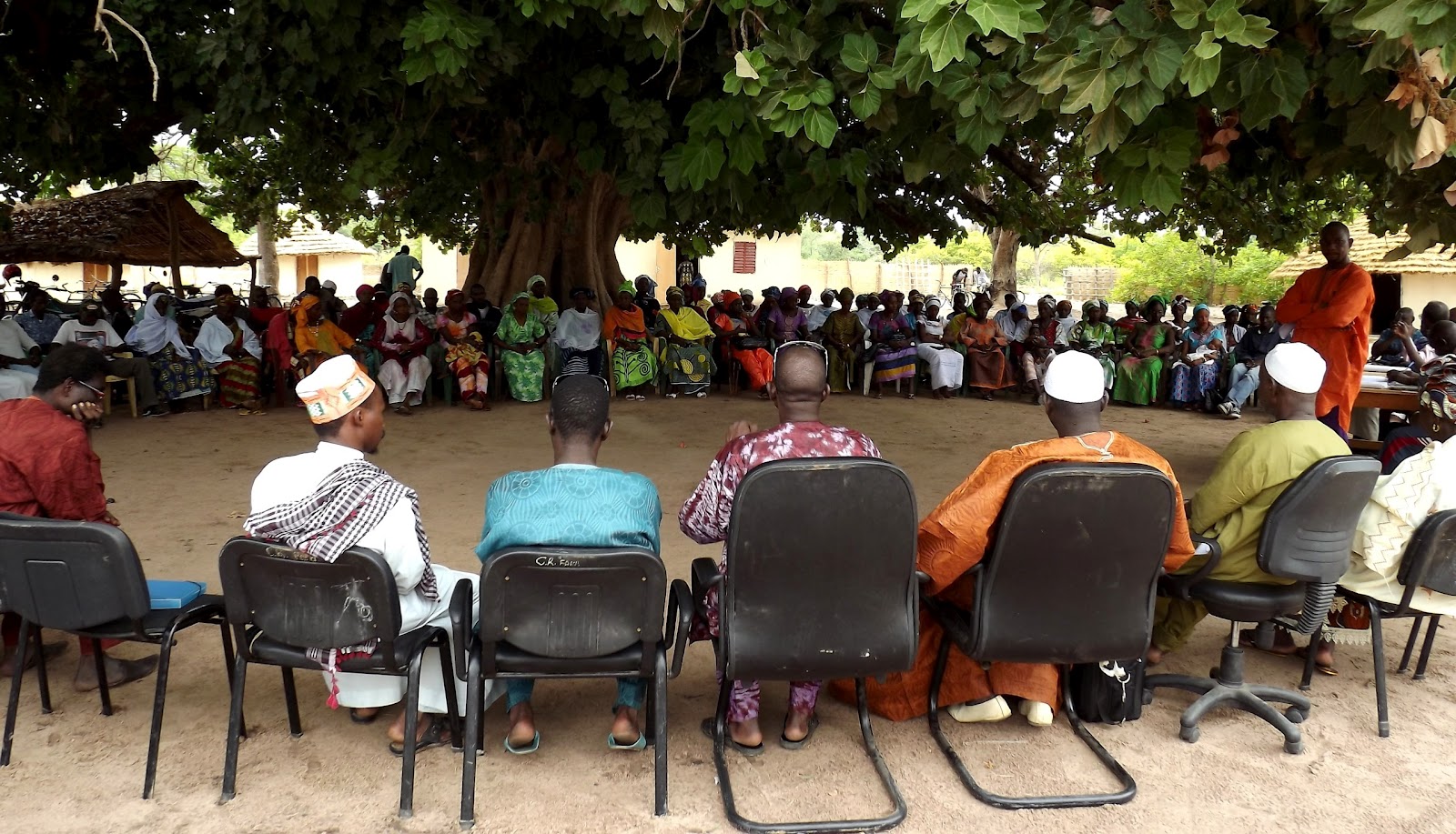
On Sunday February 24, 2013, 128 communities publicly declared their abandonment of female genital cutting (FGC) and child/forced marriage in the village of Fafacourou in the Kolda region of southern Senegal. 

Learn more about the declaration and check out the photographs taken by Tostan Volunteers, Meagan Byrne and Allyson Fritz!


Local children put on a skit, organized by Tostan Supervisor Oumar Pam, discussing the problems associated with FGC and child/forced marriage. Photograph by Meagan Byrne, Tostan.

Audience members from the declaring villages watch as local children perform a skit about the dangers of FGC and child/forced marriage. Photograph by Allyson Fritz, Tostan.
While the declaration text was being read in three languages, French, Soninke, and Pulaar, representatives from each of the 128 declaring villages stood in a group, holding up signs with their village names. Photograph by Meagan Byrne, Tostan.


Aissatou Diallo, a student from the village of Fafacourou, reads the declaration text. Photograph by Meagan Byrne, Tostan.

Mouhamadou Gano, journalist for Agence France Presse, acts as master of ceremonies for the declaration, introducing speakers and cultural acts. Photograph by Allyson Fritz, Tostan.

View more photos from the Fafacourou declaration in our Flickr photostream!


Monday, January 21, 2013

Social Mobilization Agents play key role in the movement for FGC abandonment in Kolda, Senegal


Article by Angie Rowe, Tostan Volunteer in Kolda, Senegal
What is the key to mobilizing entire social networks around the promotion of human rights? The answer is to utilize the greatest and most effective advocates for positive change: passionate community members themselves, social mobilization agents. 
Social mobilization is organized information-sharing through awareness-raising campaigns and activities.  In villages who are participating in Tostan’s Community Empowerment Program (CEP), teams of social mobilization agents are created to extend the reach of knowledge shared in CEP classes. This ensures that entire networks of people are informed and feel a part of any decision to promote positive social change in their area. Social mobilization teams also organize inter-village meetings to discuss important issues and achieve consensus on decisions affecting the extended social network.
As part of our continuing partnership with Orchid Project, two social mobilization teams were created in Kolda and Sédhiou in southern Senegal to lead awareness-raising activities that will engage neighboring communities around human rights and accelerate the movement for female genital cutting (FGC) abandonment in regions where rates are the highest. Read more about this social mobilization project in a great article on Orchid Project's blog.  
Each team consists of a supervisor and five social mobilization agents specifically selected for their skills in communication and their dedication to positive social change. This week we’re introducing you to the social mobilization team of Kolda and check our blog next week for the social mobilization team of Sédhiou!
The social mobilization team of Kolda working together to plan upcoming social mobilization activities in the region.
Thierno Yaayaa, Supervisor, Kolda

Thierno has been working for Tostan for nearly ten years, and is extremely experienced in social mobilization activities. One of his key areas is health, particularly in remote rural villages where access to healthcare is limited. His work with Orchid Project is a continuation of years of passionate service in the effort to help communities abandon harmful practices that hinder positive social change in Senegal. When he is not busy working with communities, Thierno likes to farm and occasionally works as a local merchant.

Fatoumata Balde, Social Mobilization Agent (SMA), Kolda
Born and raised in Kolda, Fatoumata enjoys creating positive change in local communities. She believes her work with Tostan is necessary and will aid the development of impoverished communities and decrease the rate of violence against women and children. As a social mobilization agent, she hopes to use her passion and her beliefs to promote FGC abandonment throughout Kolda. When not working, Fatoumata sells goods at the local market.
Lamarana Balde, SMA, Kolda
Lamarana is a Koranic scholar who enjoys working for Tostan because he believes that community participation is important to the development of his region. He hopes that the social mobilization teams are able to deliver important and accurate information to local villages, and in doing so, encourage them to abandon practices that are harmful to their health and development as a community. When not working with Tostan, Lamarana does agricultural work and teaches children in his village.
Moussa Diallo, SMA, Kolda
Moussa is a Marabout (religious teacher) in his village in Kolda. He works with Tostan because he is passionate about local health, youth education, and democracy. Moussa believes that complete abandonment of FGC is necessary to achieve progress throughout Senegal. When he is not working with Tostan he teaches the Koran to youth in his community.
Fatoumata Binta Balde, SMA, Kolda
Fatoumata believes that working with Tostan is extremely important, and she is dedicated to addressing the issues faced by young women and girls, specifically those related to child/forced marriage and FGC. She is particularly keen to share important knowledge about health with communities.  When not at work, Fatoumata enjoys cooking and finding new ingredients at the local markets.
Keloutang Diao, SMA, Kolda
Keloutang was born in Kolda and has seen the importance of good health in his village firsthand. He works with Tostan to fulfill important health needs in local communities that he believes are critical for development. Being a member of the social mobilization team, gives him the ability to directly participate in the development of his country. Outside of work he enjoys tending his garden and working with livestock.
The above portraits are based on short interviews that were held on an informal, respectful, and voluntary basis in the participants’ own language, with the assistance of an interpreter.


Monday, December 31, 2012

Community Management Committee Encourages Income Generating Activities through Fabric Dyeing Session

Story by Angie Rowe, Tostan Volunteer in Kolda, Senegal 

Our year-end fundraising campaign concludes today. Throughout this campaign, we have been highlighting different stories from Community Management Committees (CMCs) - democratically selected groups in each community trained in project development and management. CMCs plan and carry out local initiatives and truly lead the way in community development, providing inspiration as we head into the year 2013. Support their efforts by donating today and have your gift matched by The Greenbaum Foundation! 


Sikilo, a small community in the Kolda region of Senegal, completed Tostan's Community Empowerment Program (CEP) in June of 2012. The CMC remains active, engaging in activities such as trainings on soap making and fabric dyeing, community wide clean-ups, and community fund distribution. 


CMC members in Sikilo were trained in fabric dyeing to generate income for their community
In August, the CMC organized a fabric dyeing training, which was attended by all 17 members. During the training session participants learned how to mix dye, practiced fabric dyeing techniques, and discussed effective sale strategies. The fabric subsequently produced is sold in various markets throughout Kolda, providing necessary funds to support further development activities led by the CMC. 

Friday, July 6, 2012

Discussing the Abandonment of FGC and Child/forced Marriage in Kolda

Story and photographs by Angela Rowe, Tostan Regional Volunteer in Kolda, Senegal

Participants at the two-day Tostan workshop in Fafacouru.
Sixty villages in southern Senegal have just completed Tostan’s Community Empowerment Program (CEP).  The villages in the department of Medina Yoro Foulah have spent the last three years working with Tostan to increase literacy and local engagement in projects centered on education, health, hygiene, human rights, and democracy.

Topics such as female genital cutting (FGC) and child/forced marriage are discussed at the community level through participation in the program.

A woman participant works with her
group to generate ideas for handling
violence at the community level.
On June 25th and 26th, Tostan held a two-day workshop in Fafacouru to discuss human rights and democracy and community-led initiatives to end FGC and child/forced marriage.  This workshop was attended by over 150 people, including Tostan staff, program participants from eight different villages, Community Management Committee (CMC) members, NGO partners, and other local leaders.


The workshop began with Mamoudou Camara, Assistant Coordinator of Tostan Kolda, asking the participants to share their expectations for the workshop.  Together the community discussed their desire to further understand Tostan’s strategy and program, to discuss the importance of human rights in regards to both positive and negative social norms, and finally, to generate a sense of community involvement for the abandonment of FGC.  The workshop consisted of presentations regarding Tostan’s values and mission, program implementation and subsequent results. Participants were encouraged to ask questions and share their thoughts with the group, several of whom cited Tostan’s CEP as being an essential component to creating positive social change in their own communities.

One inspiring part of the workshop was when a Tostan presentation on human rights prompted a lively and impassioned dialogue among the participants.  In small groups, community members discussed the types of violence and discrimination they had personally witnessed or experienced, and subsequently generated ideas of how to handle these situations should they arise again in the future.  The recognition of basic human rights, they concluded, was the first step in confronting negative social norms.  After sharing and presentation sessions, the conversation naturally unfolded into a reflection on one of the most sensitive community issues: FGC.

Imam of Fafacouru speaks out
about the harmful consequences of FGC.
FGC, a practice once viewed by many to be an essential piece of traditional culture, can result in higher rates of maternal and infant mortality, fistulas, and other serious health problems for girls and women. After three years of non-formal education, participants were able to participate in open dialogue about these issues and come to a decision together around the necessity to abandon the practice.

At the end of the workshop, Tostan was asked to further extend their program into surrounding villages.  The department of Medina Yoro Foulah hopes that through the process, all its villages will soon declare total abandonment of both FGC and child/forced marriage.

Though the education about human rights through Tostan’s CEP was certainly a catalyst for change, as demonstrated through the workshop and by people coming together to discuss these issues, the most powerful and sustainable forms of social change come from the communities themselves.


Tuesday, May 8, 2012

"African Heat": Communities Bridge Boundaries at Peace and Security Project Launch

Story and photographs by Alisa Hamilton, Tostan Communications Assistant in Dakar, Senegal

“I learned a lot of things. I saw very dynamic communities. I saw communities who have not forgotten where they come from because they resolve problems using solutions from their own culture."
                          -Odile Tending, Program Manager at Gorée Institute  


Women from Tankanto Maoundé dance with
the image Tostan uses to represent
the right to peace and security.
On April 22, 2012, Tostan launched its Peace and Security Project in the village of Tankato Maoundé in the department of Kolda, Senegal. Funded by the Swedish International Development Agency (Sida), this project aims to address issues of peace and security in West Africa by connecting grassroots communities and their social networks with regional and international institutions. With this increased collaboration, regions, and nations as a whole, can work together to identify barriers to the peace and security of their area and create solutions that will overcome those barriers. Tankato Maoundé community members and Tostan delegations from The Gambia and Senegal participated in the event alongside project partners* and donors. The celebration included speeches, songs, and plays promoting human rights and its important role in achieving peace and security.

Abdoulaye Kandé, Tostan Regional Coordinator of Kolda, described Tankato Maoundé as a very “dynamic” community. He remarked, “We’ve noticed this since the implementation of the [Community Empowerment Program].” Abdoulaye was proud to host the event in his district: “The Peace and Security Project is very important in Senegal.” “Beside us [in southern Senegal], there is The Gambia, Guinea-Bissau, Guinea, and Mauritania. I think that [the project] must begin in Kolda in order for there to be peace in this region,” he concluded with a smile.

Awa Ballé Cissé of Sedhiou, Senegal presents
the right to health: “Health has no borders."
During the Kolda delegation’s presentation on human rights, Community Management Committee (CMC) member Awa Ballé Cissé from Sedhiou emphasized that “health has no borders.” Sedhiou’s CMC leads awareness-raising campaigns on family planning and vaccination in their village and throughout the region. “We went all the way to The Gambia to raise awareness,” she proudly shared while holding up the image Tostan uses to represent the right to health. She continued, “We must work hand in hand to achieve our objectives.”

The Peace and Security Project focuses on building ways to overcome barriers that limit an individual’s ability to develop, for example barriers to learning. “Education has no age,” stated the CMC Coordinator Abdoulaye Kebé from the village of Karsia. Karsia’s CMC has continued literacy and numeracy initiatives in their community even after the completion of the CEP and actively encourages the participation of all ages. They also work hard to improve the conditions of schools. By collaborating with local marabouts or religious leaders to improve the conditions of daaras (koranic schools), Karsia’s CMC demonstrates that education has no age or religion.
Tostan Executive Director, Molly Melching (left),
presents the human rights booklet to the
community, project partners, and
local government officials.

During the presentation on human rights, the Kolda delegation emphasized the importance of health and education in peace and security. “Today we must first think about health and education,” proclaimed Sowa Baldé of Kolda. Her community has created committees responsible for resolving conflicts peacefully. “We cannot have peace and security without health and education,” she concluded. Her final comment illustrates the importance of a holistic, human rights approach in achieving peace and security. Individuals must understand their fundamental rights, such as the rights to health and education, before communities, regions, and finally countries can respect them. Tostan’s Peace and Security Project is unique because, unlike many policy and government focused programs, its approach begins at the community level with discussions on these very topics. 

Illustrating the importance of bridging gaps between donor agencies and field work—a main goal of the Peace and Security Project—representatives from Sida also partook in the day’s festivities. Jonas Bergström, Sida Program Manager, summed up the project’s collective efforts to bridge countries, ages, religions, and ethnic groups in his closing words to the community:
“We come from a very cold place and what we have learned from Africa is the African heat. This heat is turned into energy and is capable of changing the world. I am confident that the people here along with organizations like Tostan can change today into a better tomorrow.”

To view a full photo album from the Peace and Security Project launch, click here.

To watch video footage and interviews from the event, click here.

To read this article in French of Tostan France's website, click here.
----- 
*Project partners present included The Gorée Institue, Alliance of Migration, Leadership and Development (AMLD), African Center for the Constructive Resolution of Disputes (ACCORD), Femme Africa Solidarité (FAS), West African Network for Peacebuilding (WANEP), Network of Peace and Security for Women in the ECOWAS Region (NOPSWECO)
 
Blog adapted by Salim Drame