Showing posts with label child/forced marriage. Show all posts

Friday, April 19, 2013

Using social mobilization techniques to grow the movement for the abandonment of female genital cutting

This post originally appeared on Orchid Project's blog on April 17, 2013 and is reproduced with Orchid Project's permission. To view the original post on the Orchid blog, click here

Story by Allyson Fritz, Tostan

When looking at the number of villages who have decided to abandon FGC, over 5,500 in Senegal alone, it’s easy to forget just how difficult it is to shift this social norm. In many villages in Senegal, as in other countries, female genital cutting (FGC) is a tradition deeply embedded in the culture. Communities that practise FGC may think it is important because it has been done for as long as they can remember, or they may be subject to the misconception that it is a requirement of Islam.

Tostan social mobilization teams address concerns like these in a respectful manner while sharing information on the harmful effects of FGC and, specifically, how other communities in their social networks are choosing to abandon. In partnership with the Orchid Project, the social mobilization team based in the Kolda region of Senegal conducts a 12-day long visit to multiple communities every month. Their goal is to share information and facilitate discussions in communities about human rights and the harmful traditional practice of FGC, as well as the growing movement to abandon the practice.
Through this dialogue, communities are able to discuss the harmful consequences of FGC and why other communities like their own are abandoning the practice. Collectively, they are then able to decide for themselves if they want their community to join others in abandoning.  At times this process can be rapid, but most often it occurs slowly as communities build their understanding of human rights and how the practice of FGC hinders the development of their community.   

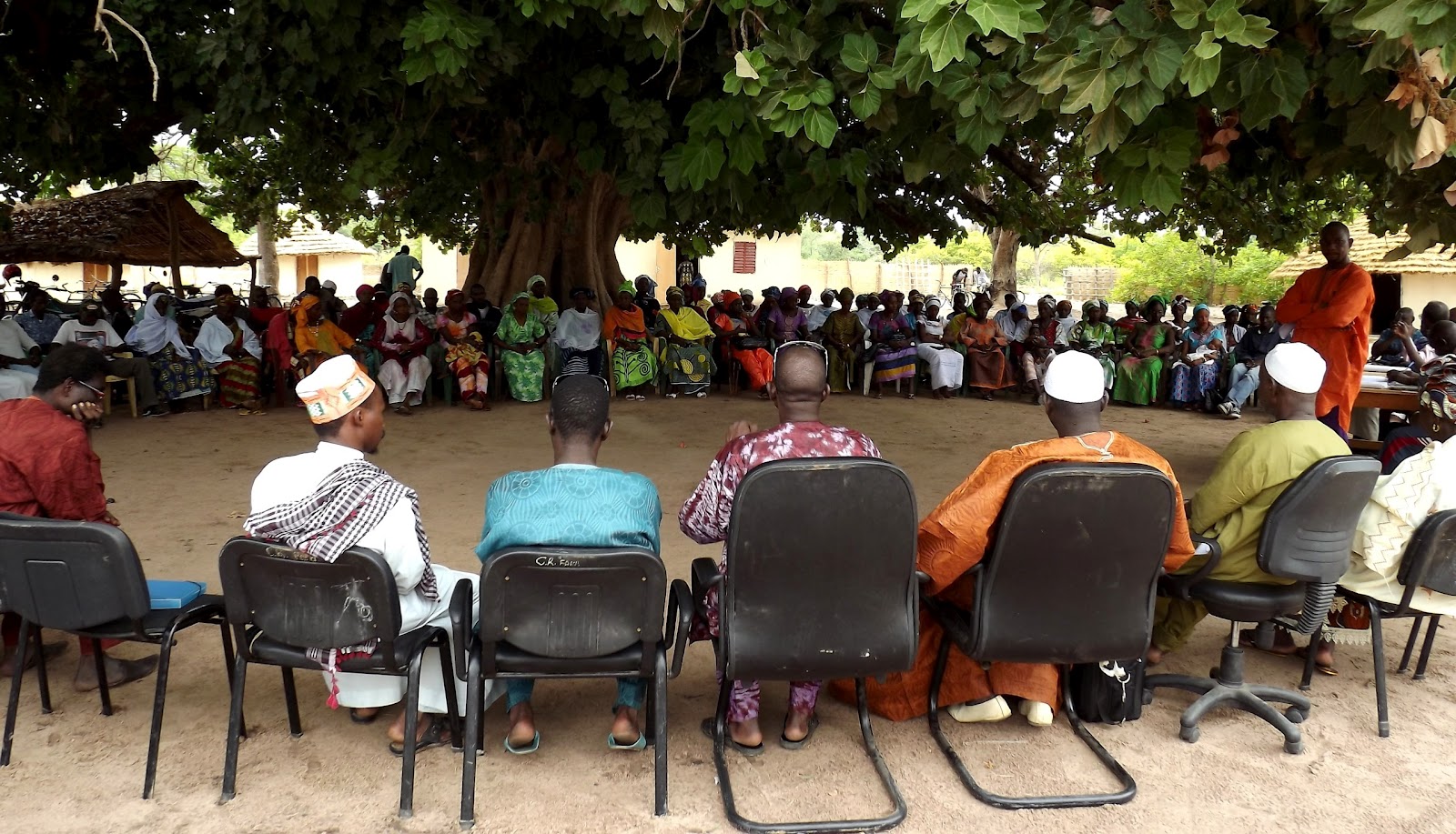
When the team works with a community, they start by spending the first day with key members of the village, including the village chief, imam, president of the women’s group, school director, elected representatives, and president of the youth group.  They introduce themselves and inquire as to whether or not they may conduct a village meeting the following day at a time convenient for the village. If the village agrees, the team will spend the night in the village and facilitate the meeting the following day.

It is critical to get the support and approval of these persons of authority before beginning any meetings with the rest of the community. They are respected voices within their communities and without their consent, it would be very difficult for the team to gather the community and share their knowledge, experiences and information.

At the appointed time on the second day of the team’s stay in a village, the meeting is convened and everyone is invited to participate. The team structures the meetings so that they start out with general information and slowly move into more sensitive topics.  The rationale behind this is that if the team jumps right into discussing FGC, which has been a taboo subject for so long, the community may be hesitant to share because they do not know the team or their purpose.

By transitioning slowly from talking about human rights, specifically those rights of women and children, and moving into violence committed against women and eventually FGC, the community is able to get a sense of who these agents are and what they are trying to accomplish. They are then more likely to feel comfortable enough to engage in a dialogue.

Thursday, February 28, 2013

NEW PHOTOS: Public Declaration in Fafacourou, Senegal

On Sunday February 24, 2013, 128 communities publicly declared their abandonment of female genital cutting (FGC) and child/forced marriage in the village of Fafacourou in the Kolda region of southern Senegal. 

Learn more about the declaration and check out the photographs taken by Tostan Volunteers, Meagan Byrne and Allyson Fritz!


Local children put on a skit, organized by Tostan Supervisor Oumar Pam, discussing the problems associated with FGC and child/forced marriage. Photograph by Meagan Byrne, Tostan.

Audience members from the declaring villages watch as local children perform a skit about the dangers of FGC and child/forced marriage. Photograph by Allyson Fritz, Tostan.
While the declaration text was being read in three languages, French, Soninke, and Pulaar, representatives from each of the 128 declaring villages stood in a group, holding up signs with their village names. Photograph by Meagan Byrne, Tostan.


Aissatou Diallo, a student from the village of Fafacourou, reads the declaration text. Photograph by Meagan Byrne, Tostan.

Mouhamadou Gano, journalist for Agence France Presse, acts as master of ceremonies for the declaration, introducing speakers and cultural acts. Photograph by Allyson Fritz, Tostan.

View more photos from the Fafacourou declaration in our Flickr photostream!


Monday, January 28, 2013

The Social Mobilization Team of Sédhiou, Senegal plans to make an impact on FGC abandonment in their region

Article by Angie Rowe, Tostan Volunteer in Kolda, Senegal


What is the key to mobilizing entire social networks around the promotion of human rights? The answer is to utilize the greatest and most effective advocates for positive change: passionate community members themselves, social mobilization agents. 
Social mobilization is organized information-sharing through awareness-raising campaigns and activities.  In villages who are participating in Tostan’s Community Empowerment Program (CEP), teams of social mobilization agents are created to extend the reach of knowledge shared in CEP classes. This ensures that entire networks of people are informed and feel a part of any decision to promote positive social change in their area. Social mobilization teams also organize inter-village meetings to discuss important issues and achieve consensus on decisions affecting the extended social network.
As part of our continuing partnership with Orchid Project, two social mobilization teams were created in Kolda and Sédhiou in southern Senegal to lead awareness-raising activities that will engage neighboring communities around human rights and accelerate the movement for female genital cutting (FGC) abandonment in regions where rates are the highest. Read more about this social mobilization project in a great article on Orchid Project's blog. 
Each team consists of a supervisor and five social mobilization agents specifically selected for their skills in communication and their dedication to positive social change. We introduced Kolda’s social mobilization team last week, and now we are glad to introduce to you the social mobilization team of Sédhiou, Senegal! 

Abdoulaye Kebe, Supervisor, Sédhiou

Abdoulaye works for Tostan because he strongly believes in the promotion of human rights and the preservation of human dignity. Excited to be a part of this new project, he hopes to use his previous experience with social mobilization activities to support positive behavioral change in villages throughout Sédhiou. Outside of work Abdoulaye enjoys reading the Koran and tending his garden.  

Mariama Doumboya, Social Mobilization Agency (SMA), Sédhiou
In the past, Mariama worked for Tostan as a Community Empowerment Program (CEP) facilitator in Sédhiou, where she focused specifically on social mobilization activities. She continues to work with Tostan to increase her knowledge of human rights and health and share that knowledge with communities. In her free time, Mariama loves to cook—especially dishes with couscous. 
Mamadou Sao, SMA, Sédhio
Mamadou was born and raised in Sédhiou and is very passionate about improving the well-being of people in his region. He is particularly interested in helping to bring an end to violence against women and children. He hopes that as a member of the social mobilization team he can provide information to villagers, encouraging them to abandon harmful practices such as female genital cutting (FGC), child/forced marriage, and early pregnancy. Outside of work he enjoys playing soccer, scrabble, and reading.
 
Seydi Bouba, SMA, Sédhiou
Seydi is an advocate for education rights and enjoys working for Tostan as its program makes nonformal education accessible to community members. He is interested in working with Orchid Project because its goal aligns closely with something he is passionate about: the abandonment of FGC. He hopes to use his skills to inform people of the harmful consequences of FGC and child/forced marriage throughout the duration of this project. Outside of work he enjoys farming and other agricultural activities.  
Mouskeba Konte, SMA, Sédhiou
Born in Sédhiou, Mouskeba has always felt passionate about health issues in her community. She was happy to find work that supported her beliefs and hopes that the work of Tostan will further develop her country positively. She is excited to be part of the social mobilization team where she can use her knowledge and experience to prompt meaningful discussion in local communities.  She hopes this work will eventually lead to total abandonment of FGC in Senegal. Although Mouskeba is kept busy as a member of the social mobilization team, she always makes time outside of work to spend with her children.
Bamba Lylla Marena, SMA, Sédhiou
Bamba believes that education and literacy are key components of sustainable development, and he enjoys working with Tostan in its efforts to accomplish these goals. He believes that child/forced marriage and FGC pose serious and significant health problems and hinder the development of Senegal in general. He believes that total FGC abandonment is both necessary and possible. When not working, Bamba enjoys playing the piano and socializing with friends.

The above portraits are based on short interviews that were held on an informal, respectful, and voluntary basis in the participants’ own language with the assistance of an interpreter.

Friday, December 21, 2012

Community Management Committees Encourage Education for All Community Members in Guinea


Story and photos by Julie Dubois, Assistant to the National Coordinator, Tostan Guinea

Our year-end fundraising campaign is going strong! This year, The Greenbaum Foundation will match every gift received, which means your impact will be instantly DOUBLED! 

As a part of our campaign, we will spotlight different stories from Community Management Committees (CMCs) - democratically selected groups in each community trained in project development and management. CMCs plan and carry out local initiatives, laying the foundation for community-led change and ensuring the sustainability of the Tostan program. Contribute to sustainable development by donating today!

“With solidarity, all is possible,” explains the CMC Coordinator Lansanna Souhmah in Brika, a village in lower Guinea.  Brika began the Community Empowerment Program in 2004, one of the first villages to participate in Tostan’s program in Guinea.  Joined by neighboring villages, Brika participated in the first public declaration for the abandonment of female genital cutting (FGC) and child/forced marriage in Guinea on June 9, 2008. Since that day the Community Management Committee (CMC) has continued to champion human rights in Brika as well as mobilize support in other communities for social change.


Members of the CMC and their children in Brika, Guinea

Education has completely transformed the residents of Brika.  Like many early Tostan partner communities, Brika participants did not benefit from the literacy and project management modules that were later incorporated as core elements of Tostan’s CEP.  Despite this, the CMC took the lead in establishing a learning center where, three times a week for the past several years, women and men have learned how to read and write in their national language.

Before the community of Brika began the CEP, community members did not send their children to school.  Education was not a priority, especially because the nearest school was located too far away.  Although Brika is about a mile from the school in Tougnifily, children had to take a detour of nearly eight miles to cross the river that intersects the two communities. The CMC raised awareness about the importance of education for each and every child, and the community became determined to build a bridge so that the children could easily travel to and from school. Now, every child in Brika receives formal education.  The CMC is even mobilizing once again to raise funds to reinforce the bridge, ensuring community access for years to come.

If you come across Brika children running across the bridge and ask them to tell you about their favorite subjects, you will hear girls’ answers filled with hope and ambition.  They dream of becoming ambassadors, social workers, and even journalists.  All of them recognize that their dreams would not be possible without education.  And the adults in the community agree that by abandoning child/forced marriage, girls will stay in school and have brighter futures.

For many children from Brika, they will be the first in their families to complete formal education.  For two junior high students, Mohammed Ali Camara and Abdoulaye Barry, schooling has opened the path for more opportunities.  They, along with many others, have a strong will to attend school and relish in the fact that they will decide their own futures.


Mohammed Ali Camara and Abdoulaye Barry will be the first
in their families to complete formal education
  
In countries where Tostan works, there are thousands of communities like Brika that have improved the lives of women, men, and children through their participation in Tostan’s proven model of nonformal education.  The CEP reinforces human rights, while CMCs take the lead on development projects that promote the well-being of every woman, man, and child in the community.  

Thursday, October 25, 2012

Back to School: Tostan Classes Recommence With the End of the Rainy Season

Every year, communities in West Africa participating in Tostan’s Community Empowerment Program (CEP) take a break from class activities during the rainy season. During this time, families devote their energy to harvesting crops. In this article by Lilli Loveday, Tostan Regional Projects Assistant in The Gambia, Tostan participant, Aminata Jallow, shares her excitement for CEP classes to recommence. 


Aminata, 15, lives with her family in Jendeh, a community in the Upper River Region (URR) of The Gambia. Her community began Tostan’s three-year Community EmpowermentProgram (CEP) in the spring of 2011. With the rainy season over, Aminata is eager to recommence Tostan classes sharing: “Just before the centers closed for the rainy season, we were raising awareness about [female genital cutting (FGC)] and child/forced marriage. We are all getting ready to publicly declare abandonment of these practices.”
Aminata, who previously shared that she was hesitant about joining Tostan classes because she heard that they focused entirely on FGC, explains: “I have seen that Tostan does not just focus on FGC. I learned a lot of things that have no connection to FGC.” Tostan’s holistic program covers the topics of human rights, democracy, health, hygiene, problem solving, literacy, math, and project management.
In Tostan classes, Aminata was informed about the practice of FGC in a context that has allowed her to explore the impact that practices such as FGC and child/forced marriage have on women and girls’ health and human rights, and she has been encouraged to come to her own conclusion. Aminata states: “I do not think that the practices of FGC or child/forced marriage are good because you should not force things on people, and it is a forced thing.”
This year, Aminata will enter Grade 6 at Koranic School. She aspires to continue her education and find employment. Last year, Aminata intended to become a Koranic teacher but has since changed her mind: “I would like to be a nurse. It will mean I can care for others.” Aminata’s commitment to her education has remained firm: “To become a nurse, I have to concentrate especially on English and Science. We learn those things now even at Koranic School.” In order to provide students at Koranic schools with the same opportunities as pupils at English schools, the Government of The Gambia introduced a new curriculum to include English and other core subjects into Koranic education.
Furthermore, Aminata looks forward to gaining the valuable skills of reading and writing in Mandinka, her native language, in the upcoming Tostan class sessions: “I will learn how to read and write and that will help me to work here in Jendeh, for my people.”
Aminata, like most of the people from her community, has been busy over the last couple of months with the growing of groundnuts, one of the most important crops of The Gambia. During the rainy season and harvest, both Tostan classes and Koranic classes have paused but they will soon restart, and Aminata is excited about getting back to studying: “It is important to help with the harvest to support my family and my community, but I am happy that I will soon be learning again.”


Wednesday, September 19, 2012

MDG3 in Action: Health and Human Rights


In support of the Global Festival, we will post a story each week during the month of September featuring Tostan's commitment to Millennium Development Goal 3 (MDG3), 'Promoting Gender Equality and Empowering Women' in the series MDG3 in Action.

Join us in the movement to end extreme poverty by becoming a Global Citizen. Watch, view, and share stories on the Global Citizen website to earn tickets to the Global Festival!

Leading Health and Human Rights Initiatives in Sahre Bookar

Story by Anna Vanderkooy, Tostan Projects Assistant, Senegal
Ramatou and her daughter Miriama

Mamadou Ramatou Diallo (Ramatou) lives in Sahre Bookar, Senegal. She is the Coordinator of the Health Commission of Sahre Bookar’s Community Management Committee (CMC). Sahre Bookar formed a CMC when it began Tostan’s Community Empowerment Program in 2010. Composed of up to six commissions (health, environment, child protection, education, income-generating activities, and social mobilisation), the CMC is a 17-member democratically-selected group that organizes awareness-raising events and leads development projects designed by the community. A minimum of nine of the members are women.

In 2011, inspired by the knowledge of health risks and human rights violations gained in Tostan's Community Empowerment Program (CEP), her community of Sahre Bookar held a village-wide meeting to discuss the abandonment of FGC and child/forced marriage. Consensus was reached, as community members confirmed that these two practices harmed the well-being of girls and women in the community. 

Now, as the head of her community's Health Commission, Ramatou is confident that all girls in the community, including her 13-year old daughter Miriama, will benefit greatly from this new respect of their rights. Girls were formerly married as young as 13 to men of their parents' choosing, but today they are assured the right to remain in school and to choose their own husbands after the age of 18. 

Through the Health Commission, Ramatou has organized a number of awareness-raising campaigns in the community related to vaccinations, malaria, and risk reduction during pregnancy. She has seen changes since the arrival of the program, citing that all villagers now sleep under mosquito nets, parents now respect the vaccination calendars set out by the local health post, and expectant mothers attend pre- and post-natal consultations, giving birth at local health centers instead of at home. 

Ramatou also started a health fund, with everyone in the village contributing 100 CFA ($0.25) three times a year. This fund supports health initiatives in the community, giving loans to villagers to assist them in the payment of hospital fees and transportation to appropriate facilities. Next year she hopes to use money from this fund, along with support from the local health post, to start a health closet that will ensure access to basic medication in Sahre Bookar.

With her knowledge and skills gained from the Tostan program, Ramatou has been empowered to play a leadership role in her region of Senegal, striving for better health and well-being for Sahre Bookar and surrounding communities. 

Friday, August 3, 2012

The Elders Bring Attention to Child/Forced Marriage in The Washington Post

Article by Courtney Petersen, Communications Officer in Washington DC.

CEP participants at the 3rd Annual Youth Caravan in The Gambia.
On July 31st, two founding members of The Elders, Graça Machel and Desmond Tutu, brought much needed attention to the global issue of child/forced marriage. Writing in The Washington Post, they called for urgent action saying: “At current rates, 100 million girls will marry as children in the next decade.”


They illustrate the inseparable link between child/forced marriage and the continuance of poverty - when a girl is married too young she is much more likely to drop out of school, experience health complications during childbirth, and can be vulnerable to domestic violence. If she is able to stay in school, she is less likely to experience these negative consequences and more likely to be able to contribute to her community and society at her full potential.

Graça Machel and Desmond Tutu also talk about the hope that exists for many girls worldwide who once faced this stark reality, saying that child/forced marriage no longer has to be an obstacle in their development. Specifically, they mention the transformation that is being led by communities in Senegal - thousands of communities joining together to declare their decision to abandon the practice of child/forced marriage. Many of these communities are direct participants of Tostan’s human rights-based Community Empowerment Program (CEP). 

Though positive change is occurring, The Elders reiterate that we all must continue to build momentum for this movement.  By working with communities in Africa and around the world; gaining support from local and national governments; and collaborating with international organizations like The Elders and our partner Girls Not Brides, we hope that the decline of child/forced marriage will only accelerate.


Friday, July 6, 2012

Discussing the Abandonment of FGC and Child/forced Marriage in Kolda

Story and photographs by Angela Rowe, Tostan Regional Volunteer in Kolda, Senegal

Participants at the two-day Tostan workshop in Fafacouru.
Sixty villages in southern Senegal have just completed Tostan’s Community Empowerment Program (CEP).  The villages in the department of Medina Yoro Foulah have spent the last three years working with Tostan to increase literacy and local engagement in projects centered on education, health, hygiene, human rights, and democracy.

Topics such as female genital cutting (FGC) and child/forced marriage are discussed at the community level through participation in the program.

A woman participant works with her
group to generate ideas for handling
violence at the community level.
On June 25th and 26th, Tostan held a two-day workshop in Fafacouru to discuss human rights and democracy and community-led initiatives to end FGC and child/forced marriage.  This workshop was attended by over 150 people, including Tostan staff, program participants from eight different villages, Community Management Committee (CMC) members, NGO partners, and other local leaders.


The workshop began with Mamoudou Camara, Assistant Coordinator of Tostan Kolda, asking the participants to share their expectations for the workshop.  Together the community discussed their desire to further understand Tostan’s strategy and program, to discuss the importance of human rights in regards to both positive and negative social norms, and finally, to generate a sense of community involvement for the abandonment of FGC.  The workshop consisted of presentations regarding Tostan’s values and mission, program implementation and subsequent results. Participants were encouraged to ask questions and share their thoughts with the group, several of whom cited Tostan’s CEP as being an essential component to creating positive social change in their own communities.

One inspiring part of the workshop was when a Tostan presentation on human rights prompted a lively and impassioned dialogue among the participants.  In small groups, community members discussed the types of violence and discrimination they had personally witnessed or experienced, and subsequently generated ideas of how to handle these situations should they arise again in the future.  The recognition of basic human rights, they concluded, was the first step in confronting negative social norms.  After sharing and presentation sessions, the conversation naturally unfolded into a reflection on one of the most sensitive community issues: FGC.

Imam of Fafacouru speaks out
about the harmful consequences of FGC.
FGC, a practice once viewed by many to be an essential piece of traditional culture, can result in higher rates of maternal and infant mortality, fistulas, and other serious health problems for girls and women. After three years of non-formal education, participants were able to participate in open dialogue about these issues and come to a decision together around the necessity to abandon the practice.

At the end of the workshop, Tostan was asked to further extend their program into surrounding villages.  The department of Medina Yoro Foulah hopes that through the process, all its villages will soon declare total abandonment of both FGC and child/forced marriage.

Though the education about human rights through Tostan’s CEP was certainly a catalyst for change, as demonstrated through the workshop and by people coming together to discuss these issues, the most powerful and sustainable forms of social change come from the communities themselves.


Tuesday, February 21, 2012

VOICES OF TOSTAN: Nafissatou Sabaly

Tostan Facilitator Nafissatou Sabaly sparked discussion both within her family, her native village, and throughout the social network linking the village of Néma Dianfo to neighboring communities in Senegal. These discussions catalyzed a major shift in community-wide opinion of the practices of female genital cutting (FGC) and child/forced marriage. In an interview with Will Schomburg, Tostan Communications Assistant in Dakar, Nafissatou describes her personal journey.


Nafissatou Sabaly, Tostan Community
Empowerment Program Facilitator
in Néma Dianfo, Senegal 
How does your family feel about your work?

I grew up in Yirkoye [a village in Senegal]. Since I started at Tostan, I’ve talked with my mother, my grandmother, my sisters and my brother about FGC. My mother told us that we had to [practice FGC]; that it was our custom. But when I told her, “No, it’s something that can kill,” she really started to think about it. We didn’t know the risks when I was a child. But now my brother’s daughters have never been cut—when he started having children, I took the time to talk with him about it.

Did all of your family agree with his decision?

My father didn’t have a problem with ending the practice. He pushed my mother to give it up. He understood the dangers right away when I explained them. But my mother kept asking if her granddaughters would be able to find a husband if they weren’t cut.

How did other community members respond to your views on FGC?

It was difficult to convince my home village. But every time I went back to visit, I talked with the women in my family, and especially with my brother’s wives. And they came and stayed and listened.

How did you convince them?

There’s one woman in my village who has never been able to have a child because she was cut. I explained why she couldn’t carry a child, and that really scared the women. And one of my brother’s wives had been cut when she was younger. They married when she was 14 years old and she had to have a cesarean. She was sick in the hospital for an entire month.

How did you feel about your brother marrying someone so young?

I objected. The girl didn’t know she had a choice. Her parents chose for her. After she ended up in the hospital and my brother saw what had gone wrong, he said he would never let his own daughters marry so young.

How did the rest of your family react?

Everybody saw what had gone wrong. My younger sister is 22 years old now, and my parents haven’t made her marry.

Do you think your family will continue to support her decision?

I was married when I was 17 years old, in 1990. I divorced in 1999. [My husband] wasn’t terribly cruel, but we weren’t getting along and there was occasional violence. My father thought I just didn’t want to be married. He said, “Sometimes there’s just violence in a marriage. It’s like that.” I told him: “You took me out of school to get married, now I’m moving back home and I’m going to start school again.” And I did—I found an organization, [Tostan], where I learned to read and write in Pulaar.

Now my father understands better. Every time he wants to marry my sister off, I say, “Don’t forget what happened to me. Don’t forget what happened to [my brother’s wife].” And he’ll say, “That’s right, I remember.”

Friday, February 10, 2012

"Change From Within": article by Molly Melching published in Population Connection’s The Reporter

Gambian youth vocalize their stance on child/forced marriage
 during an awareness raising march through
Basse, The Gambia in October 2011.
Youth from across The Gambia were recognized for their efforts to lead social change in a feature article published in the February edition of Population Connection’s The Reporter. The article entitled “Change from Within: Youth Leading Movement for the Abandonment of Child Marriage in The Gambia,” was written by Tostan Founder and Executive Director Molly Melching and spotlighted the energy and success of the third annual Tostan Gambia Youth Caravan. Organized by 170 Gambian youth who participated in Tostan’s Community Empowerment Program (CEP), the caravan gave teens the opportunity to share their belief in the importance of human rights with their social networks and to convey the responsibility each person has to advocate for positive, community-led change. 

To read the full article in the February edition of The Reporter on Population Connection’s website, click here.

Friday, November 11, 2011

Tostan FAQ: Education for All

In response to a brief profile of Tostan, a reader on the website Goodreads recently emphasized the importance of educating women. A common question asked of us is Why does Tostan’s nonformal education program, the Community Empowerment Program (CEP) engage women and men, girls and boys? Why don’t we focus exclusively on women?

At Tostan, we pride ourselves in being a learning organization, which means that we will make adjustments to our program if a certain initiative or approach is not as effective as we know it can be.

With that said, the first version of the Tostan Community Empowerment Program (CEP) was designed for female participants exclusively. While the program was effective in educating and empowering the women and girls who participated in the program, it also caused some distrust and tension in families when wives and daughters came home with new ideas about rights and responsibilities - ideas to which the their husbands, fathers, and other male family members had not been exposed.

When Tostan facilitators communicated this issue to leadership, Tostan shifted approaches and redesigned the program to include both women and men, adolescent girls and boys. In doing this, male and female participants learned about their human rights (as opposed to only women’s rights or children’s rights) and then in turn became advocates in their communities for the rights of both women and men. This shift has led to a human rights movement that is spreading across West Africa and parts of East Africa. To date, over 6,000 communities in eight countries have publicly abandoned the traditional practices of female genital cutting (FGC) and child/forced marriage because of such community-wide discussions of human rights.

Click here to read more about Tostan’s CEP. To read about how empowered individuals are improving their communities and leading social change, please click here. We feel that the work of our partner communities to date is a testament to what is possible when we move towards a shared vision of education as a right, fully supported for all, by all.

Sincerely,

Luzon Pahl Kahler
Director of Administration, Tostan

Friday, September 16, 2011

Education First! A Tostan participant chooses education over child marriage

Ayset Diallo, a 14-year-old girl from the village of Diamwély Peulh, Senegal, received three marriage proposals over the course of a few months. With her family’s support, Ayset rejected each suitor. Like other young girls living in the Kaolack region of Senegal, Ayset wants to get married when she is ready and to invest in her own future by continuing with her education.

Ayset and her parents
Ayset and her family are participants in Tostan’s “Empowering Communities to Empower Girls” project, also known as CEP+. In partnership with the Nike Foundation, the project focuses on improving the lives of rural adolescent girls in the Kaolack region of Senegal through the implementation of a modified version of Tostan’s Community Empowerment Program (CEP). With classes centered on human rights, health, and social norms, families have a space to openly discuss topics relevant to their lives, like child marriage and education for girls, and to make decision that will promote an empowered future for their daughters.

Click here to read more about Ayset’s story and the inspiring change being fostered through the “Empowering Communities to Empower Girls” project.

Friday, August 12, 2011

Mobilizing Change: Tostan participants featured in TrustLaw report on child marriage

Three former participants in Tostan’s human rights-based education program, the Community Empowerment Program (CEP), from Keur Issa, Senegal were featured in a video and series of articles on TrustLaw earlier this month. These articles and video are part of a TrustLaw special multimedia report on child marriage. This report aims to increase people’s awareness of the realities of child/forced marriage and to highlight those who are working to end this practice.

Click here to read more about these inspiring changemakers.

Wednesday, December 22, 2010

The village of Tankanto Mauondé, Senegal: A Village of Activists

Story by Caitlin Snyder, Tostan Volunteer in Kolda, Senegal

Rich in tradition, the village of Tankanto Mauondé prides itself on a history that spans over 400 years. These villagers speak with even more pride, however, when they discuss the future of their daughters. The next generation of girls will grow up in a community which has declared to abandon female genital cutting (FGC) and child/forced marriage.

Takanto Mauondé was once a community of Fulani farmers who cultivated rice, maize, and peanuts, crops which once constituted the main source of revenue for the original 700 inhabitants. Today, the most important value in the village is that of teranga, or Senegalese hospitality. A strong interest in the well being of others is reflected in the character of the villagers and it is this interest that influenced their participation in the Tostan program. After Tostan began implementing the Community Empowerment Program (CEP) in the community in 2008, the 76 participants – 66 women and eight adolescents – responded enthusiastically to the lessons on health and human rights. Women created a Community Management Committee (CMC), a group of 17 democratically elected individuals, and initiated awareness-raising campaigns to introduce nearby villages to the negative effects of harmful traditional practices. 

Boubakry Baldé, the husband of a CMC member, described the committee’s work: “We have seen many changes in mentality in the village and there is now greater potential for the development of young girls.” Today, the villagers speak about the importance of sending children to school, and they proudly insist that no girl will be forced to quit school due to an early marriage.

“It’s the women who took the initiative,” said the village chief’s representative. Today, women have a more central role in the village. “Before, women didn’t speak during meetings,” recalled Fatoumata Baldé, the coordinator of the CMC. “Now, even during baptism ceremonies, marriage celebrations, and religious events, women are involved in the decisions.” 

The changes brought about by the CMC are extraordinary. The CMC initiated a dialogue on the importance of birth registration as well as registering children for school. Women have won respect and now have the full support of everyone in Tankanto Mauondé, from the village chief to religious leaders.

Thanks to knowledge gained in the areas of mathematics and project management during the Tostan program, the CMC leads income generating activities such as selling vegetables and dried fish. Entrepreneurs meet two times a month to calculate their expenses and the benefits of their sales. They speak with enthusiasm regarding projects they will begin in the coming year.

The community’s decision to abandon harmful traditional practices ─ which they shared with the world in a grand declaration held on November 28th ─ shows a strong wish to preserve the health and the rights of their daughters. According to Mamoudou Baldé, “We will show the government, neighboring communities, and other countries that we have decided to abandon FGC and child/forced marriage.” On the 28th of November, the village of Tankanto Mauondé was one of 700 villages investing in the future of every girl in Senegal. 

Photos by Caitlin Snyder


Monday, December 20, 2010

91 Villages in Wack Ngouna, Senegal Abandon FGC Thanks to the Power of Social Mobilization

Story by Sydney Skov, Tostan Volunteer in Dakar, Senegal.

In the village of Wack Ngouna, I watched as dust spiraled up from the quick steps of countless dancing feet.

Celebrating a collective decision which will effectively change the future for girls in Wack Ngouna, a district near Kaolack, Senegal, hundreds gathered to watch as representatives from 91 communities shared with the nation their decision to abandon female genital cutting (FGC) and child/forced marriage

As I listened to local dignitaries speak, sharing their enthusiasm for Tostan and for the future of women and girls in the surrounding communities, I realized the magnitude of this public declaration. While a much smaller event than the giant public declaration in Kolda last month during which 700 communities declared abandonment of FGC, this declaration was particularly powerful because none of the 91 declaring villages had taken part in Tostan’s Community Empowerment Program (CEP), a 30-month, holistic education program teaching human rights, democracy, health, hygiene, and literacy, among other subjects. 

The villages of Wack Ngouna are proof of an incredible feat of community-led development: social mobilization. A group of five Community Management Committee (CMC) members – individuals who have been elected as leaders within their respective communities – was led by Tostan’s Ousmane Ndiaye and Marietou Diarrou, responsible for social mobilization in the Kaolack region. The team traveled from village to village, sharing knowledge they had gained from the Tostan program with other communities while encouraging village leaders to address issues of women’s rights and health. This  method of social mobilization allows shared knowledge to spread from one village to the next, creating a web of communities connected by the understanding that harmful traditional practices undermine the health and human rights of women and girls.

Skits performed by local youth during the celebration in Wack Ngouna illustrated their understanding of the negative effects of FGC and child marriage. One skit portrayed a 12 year old girl who was to be married to an older man in exchange for a dowry. But the girl stood up in protest saying, “the money that you put in your pocket today is the happiness that you take from me tomorrow.” She then convinced her father that she should continue her education so she could one day find a good job to help the family. 

Within the last two months alone, almost 800 villages have declared their abandonment of FGC and child/forced marriage thanks to the dedication of thousands across Senegal who, by sharing knowledge and discussing ideas learned through the Tostan program, are creating positive social change. The incredible movement continues. 

Photos by Sydney Skov and Verneva Ziga. Top- members of the performance group Alalaké. Middle- The social mobilization team in Kaolack. Below- local youth perform a skit which discussed the harmful consequences of FGC.   

Tuesday, November 30, 2010

Excitement Builds in Anticipation of Public Declaration in Kolda

Story by Sydney Skov, Tostan Volunteer in Dakar, Senegal

Equipment for the celebration makes its way 
to the village of Tankanto Mauondé in Kolda. 
 
November 26—It was a long and bumpy car ride from Dakar to the southern city of Kolda, Senegal. Two Tostan volunteers – Amma Serwaah-Panin, the Program Assistant for the Jokko Initiative, a program focusing on literacy through text messages, and myself, the Assistant to Tostan’s International Communications Team – are joining a delegation of Tostan staff from all over the country in preparation for the grand event to take place November 28: a public declaration for the abandonment of female genital cutting (FGC) and child/forced marriage.

Over 700 villages will come together this weekend to make an incredible commitment, one that will bring the country of Senegal one step closer to the total abandonment of a 2,000 year old practice which undermines the rights of women and girls. We will have the amazing opportunity to witness history in the making and to watch as over 2,000 women and men from rural communities raise their voices to help end harmful traditions.

The department-wide declaration is happening at an appropriate moment, as world leaders turn increased attention to the importance of women’s empowerment and the delicate issue of changing harmful social norms. November 25th marked the International Day for the Elimination of Violence Against Women and in a piece which ran in The Vancouver Sun, Hillary Clinton boldly stated that men are equally important in the effort to eliminate gender based violence. Through holistic, human-rights based education and a community-led approach, Tostan is helping to do just that: bring women and men together to change the course of history. 

It’s muggier here than in Dakar, the big city seems far away, but the atmosphere of excitement has already begun to seep into the Tostan office and into my little hotel room where I’m anxiously awaiting the festivities planned for tomorrow. A documentary filmmaker and I will be traveling to a nearby village with a group of journalists representing all facets of Senegalese news media. There, Tostan will hold a press conference in order to share details of the upcoming declaration. Tomorrow night will be a cultural celebration including music, dance, and cheer. I will continue to post on our blog as the events unfold!   

Photos by Sydney Skov: Top- preparations begin in the village of Tankanto Mauondé. Below- men and women dance together in the village as declaration day approaches. 

Thursday, May 27, 2010

Communities in BRAKNA Join the Momentum for FGC Abandonment in Mauritania

Mauritania Celebrates the Abandonment of FGC and Child/Forced Marriage Abandonment


MBAGNE, Region of Brakna, Mauritania, 25 May 2010—For the first time in the Islamic Republic of Mauritania, a celebration to abandon the harmful tradition practices of female genital cutting (FGC) and child/forced marriage was organized by 78 communities in the Region of Brakna.

Held in the town of Mbagne, representatives from the Hassanya and Pulaar ethic groups came together on Tuesday, May 25, to announce their commitment to promote and protect the human rights and health of girls and women. Setting the stage for further FGC abandonment in Mauritania, the communities opened a promising new chapter for women and girls in the region.

More than 7,000 people gathered at the public square in Mbagne for the day-long celebration. Communities traveled from throughout the region to participate in this historic event in the presence of important government officials such as the Minister of Social Affairs, the Child and the Family, UNICEF representatives and several other non-governmental organizations.
 
Blog adapted by Salim Drame