Showing posts with label community involvement. Show all posts

Thursday, May 24, 2012

VOICES OF TOSTAN: Emily Ice


An organization is nothing without the passion and dedication of the team of individuals behind it. Tostan is comprised of talented, committed people ranging from village elders to directors, Community Empowerment Program facilitators and participants to volunteers and interns. Each individual contributes his or her unique personality and skills to further the work of Tostan, thus creating a dynamic environment in which positive change can take place.

We highlight the diversity of interests, talents, and backgrounds within the Tostan team here on the blog in a series entitled Voices of Tostan. Specifically, we will explore what brought each unique voice to Tostan and why Tostan’s efforts to bring about positive social change are significant and meaningful to each individual.

Story by Emily Ice, Tostan Operations Assistant in Washington, DC

Ask any Returned Peace Corps Volunteer and chances are they will tell you the hardest part of the Peace Corps service is coming home. Adjusting to life back home is often much harder than adjusting to life overseas. When I returned from my service in Benin, West Africa, I was thrown for a loop. What should I do next? How would I reconcile my privileged life in the US with my intensely poor and difficult life overseas? I yearned for a way to process my Peace Corps experience and stay connected to the West African community I had become so entrenched in.

My mother’s friend stepped in to help. She had served in the Peace Corps in Benin back in the eighties and immediately knew what I was going through. She sent me a copy of Half the Sky with a note saying she hoped it would inspire me. It worked.

Overwhelmed and lost, I began reading Half the Sky. I was immediately impressed at how honestly the book exposed the complexities of the international development field. “Making a difference” and “creating sustainable change” are not easy things to do. One of the first Peace Corps lessons I learned was that projects rarely succeed on the first try.

Emily with community members in Benin
Peace Corps Volunteers are trained to be facilitators. Our role is to mobilize communities to utilize resources they already have, not to provide new ones. To succeed in the Peace Corps, one must be patient and immerse oneself in the community. This means learning the local language, embracing local customs and respecting local leadership. Furthermore, in order for a Peace Corps Volunteer’s service to be sustainable, the community must take ownership.

Tostan’s work stood out because it was founded on many of these same beliefs. Tostan’s commitment to respectful community-led development, local language, and local facilitators immediately set it apart from many of the other international development organizations I had read about. As a Peace Corps Volunteer, I respected Molly Melching. I understood the extent of dedication and patience required to be accepted by a community. Tostan’s success was testament to her understanding of the communities and her respect for their traditions. I was in awe of Molly and intrigued. I started researching Tostan’s work and grew more enthralled.

I sent in my application to the Tostan’s DC office and waited. At the time, I was working in Saint Maarten as an Environmental Education Specialist for an environmental advocacy nonprofit. I loved working on the island but my wanderlust was starting to fade and I was ready to return home. As much as I loved the hands-on work I was doing overseas, I knew that if I truly wanted to pursue a career in international development, I needed to learn about the behind-the-scenes work that supported overseas programs. When I returned home in December, I interviewed with the DC office and was thrilled to get my acceptance.


Emily with community members in Benin
When I first arrived at the DC office, my first reaction was, “I’m home.” The office was decorated in West African tapestries and colored fabrics. Smiling faces of Tostan community members shone up from every computer screen. I had forgotten how much I missed Benin. Seeing the packets of Nescafe instant coffee, the children’s books written in Mandinka, and all the African fabric on the walls immediately brought me back.

More than all that, I loved that even on our first day in the office the DC staff wanted our input about the programs being run in Africa. I finally could put some of my Peace Corps knowledge and experience to tangible use. Moreover, here were people who weren’t going to just stare blankly at me when I talked about my house flooding or traveling three hours to get a glass of milk. It was such a relief.

During my time interning with Tostan, the initial excitement of shared understanding and experiences has worn off, morphing into something more: respect. Before coming to Tostan’s DC office, I was completely naïve to how much support and planning were required to run overseas programming. Working in DC has shown me that the field of international development is diverse and consists of an array of jobs, encompassing a variety of skills and expertise. I can now envision a future, in which it is possible to balance a life in the US and abroad with a career in international development.

To read more entries from the Voices of Tostan series, click here.

Note: The opinions expressed in the Voices of Tostan blog series are those of the individual author.

Tuesday, March 27, 2012

Video: Hosting a Blood Drive and Honoring Tostan Retirees in Thiès, Senegal

Previously, Alisa Hamilton, our communications assistant in Dakar, Senegal,  shared with you two photo essays: one on a Tostan blood drive and the other on a Tostan retirement ceremony. Both events took place on February 17th, 2012 at the Centre de Capacitation pour le Developpement Durable (CCDD) in Thiès, Senegal. Below is video Alisa made of that day:

Friday, March 2, 2012

Tostan Hosts a Much-Needed Blood Drive in Thiès, Senegal

Story by Alisa Hamilton, Tostan Communications Assistant, Dakar, Senegal

In Senegal, only .25% of the population regularly donates blood compared to the average 2% of donors in other countries. As a result, the National Blood Drive Center in Senegal consistently experiences blood supply shortages, therefore limiting the number of essential blood transfusions that can be performed. Blood banks, like the one in Thiès, Senegal, rely primarily on word of mouth to mobilize potential donors in the community.

On Friday, February 17, Tostan team members rallied their social networks and hosted a blood drive at Tostan’s Training Center for Sustainable Development (Centre de Capacitation pour le Developpement Durable, CCDD) in Thiès, Senegal. On that day, 50 community members and Tostan employees made the decision to help save lives by donating their blood.  

Check out pictures from the blood drive below:

__________________________________________________________________


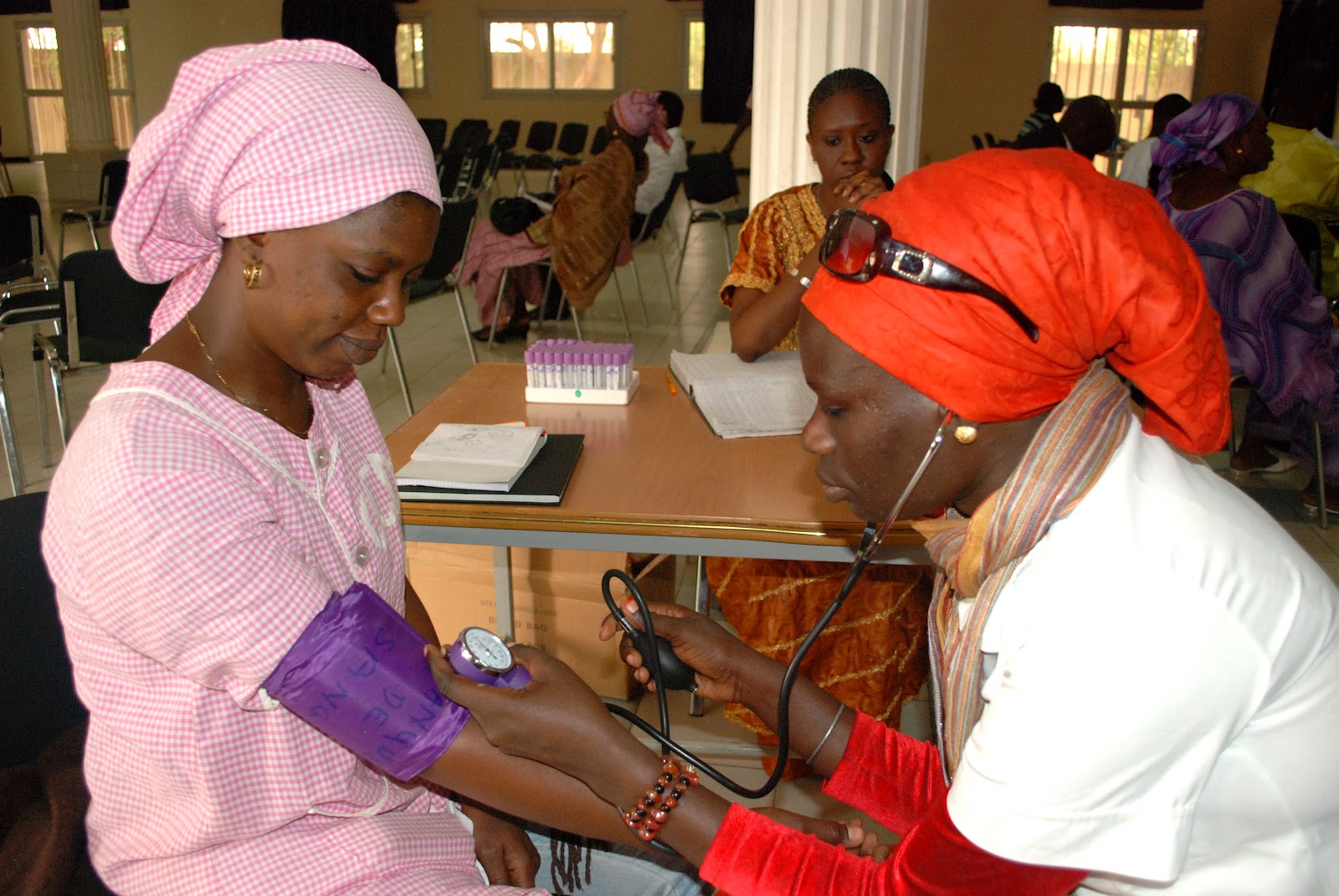
Aminata Saho, a Tostan team member at the CCDD, has her blood pressure taken. She and her friend and colleague, Ndiaye Aminata Puit, learned about the blood drive that day and both decided to donate for the first time.

**
Ardo Fall, Director of the CCDD, watches as his donation bag fills. He has given blood for four years and often travels to the hospital to give for emergency cases. When asked why he gives blood, Ardo responded, “Because it saves lives. It’s something that I respect because some day, it might be me who needs it.”

**
Smiling, Aminata stays calm during her first blood donation. She shared that she wanted to donate because giving blood can help people who are sick, such as her mother who recently received a blood transfusion. 

**
Khady Diato Sall, the donation organizer at the blood bank in Thiès, Senegal has given blood over 50 times. “[Donating blood] is a civic act,” Khady explained. “Many people don’t do it because they are afraid or they think it won’t help. But every day the hospital calls us for donations. It saves lives.”

**
Ousamane Cisso used to be afraid to give blood, but has since overcome his fear and encouraged many of his friends to donate as well. His mother works for the blood bank, and Ousamane and many of his relatives came to the CCDD to donate on the day of the blood drive.

**
Mohamed Sall (far left), Ousamane Cisso’s cousin, came to give blood for the first time. He used to be afraid of needles, but Ousamane encouraged him to overcome his fear. “I know the hospitals suffer from a lack of blood. I wanted to help people because it can save a life,” explained Mohamed. Here he poses with his friends.

**
The Cisso family after giving blood. From left to right: Ismael Cisso, Allasane Cisso, Mamie Cisso, Aliou Cisso, Boubacar Cisso.

**
Ndiaye Aminata Puit (right) poses with her friend, Sorde, after donating for the first time. 

** 
Khady Guèye (left), Treasurer of the Federation of Community Management Committees (CMC) in the region of Thiès, and Khady Mbaye Ka (right), President of the Thiès CMC Federationalso gave blood for the first time. Khady Mbaye explained, “Giving blood is a noble act. A way to manufacture blood has not yet been invented so we will always need donations.” She continued that many women, including one of her sisters, need blood transfusions during childbirth due to haemorrhaging.


Wednesday, August 10, 2011

Dakar Suburbs Prepare for a Brighter Future

Story by Eliane Luthi Poirier, Communications Assistant in Dakar, Senegal

Guediawaye is far off the tourist radar. In this suburb of Dakar, residents live in cramped, spontaneous housing with little or no sanitary infrastructure. Many of them have come from other regions of Senegal in hopes of better economic opportunities.

During the rainy season, flooding is a daily reality here. Mosquitoes breed in the stagnant waters and water-borne illnesses proliferate. Upon arriving in the Medina Gounass neighborhood, I was brought to the water retention basin that the Senegalese government had created in hopes of alleviating the problem of flooding. The wired fencing around the basin had been broken and we saw children playing in the reeds lining the stagnant water.

Through the generous support of the Rapidan Foundation and the Epstein Family, Tostan has been working in Guediawaye since 2008. It’s the only neighborhood of Dakar where our Community Empowerment Program (CEP) is run (though we are running the program in Dakar’s prisons). The 30-month program is now coming to a close, and the 100 participants – all women – are preparing for their future.
I asked Nogoye Dieng, the coordinator of the Community Management Committee (CMC) of Medina Gounass II, whether Tostan’s program had responded to the specific needs of the residents here.
Nogoye Dieng, the coordinator of the
Community Management Committee of
Medina Gounass II
One of the great successes of the program, she said, was ensuring the local children went to school. “Before, people didn’t have papers here. Parents couldn’t sign up their children for school because the children didn’t have birth certificates. Now, when a child is born, his/her parents make sure to obtain papers.” Because of this, she explained, the number of children attending school has shot up.


CEP participants contributing a weekly sum
to their community fund
The other success story, she told us, was the establishment of a community fund and the teaching of income-generating activities, including soap making, the grinding of grains, beadwork, sewing and dyeing fabrics. The head of these activities, Marieme Fall, is blind. As the president of a regional association of the blind, she has much experience conducting income-generating activities for the members of her association. She may need help to find her way around, but her sharp wit and her long experience in the field commands a high level of respect among her fellow participants.

The community fund operates on the principle of solidarity, or jappal ma japp. Every Monday and Thursday, the group meets and each member makes a fixed contribution to the fund. The money is then given to one participant, on a rotating basis, and she invests the money in her income-generating activity.

Awa Ndiaye, a youth participant in the
program, has learned to read and write in Wolof

Half of the participants in the program are teenagers and young women. Many of them have come to Guediawaye to work as domestic workers. Awa Ndiaye was one of them. She told us she used to walk in front of the Rapidan Centre on her way to work and was curious to find out more. Now, after attending the program, she can read and write in Wolof. When she goes back to her home village, she said with pride, she can teach her family what she has learned. A fun part of the program, she added, was learning how to use her mobile phone to send text messages.

Today, Medina Gounass is celebrating all that they have achieved over the past three years at a social mobilization event. Music, animations, skits and games are all part of the festivities. A young girl is called up to recite the pillars of democracy. Not missing a beat, she lists all that she has learned in program.

Despite the festive mood, Nogoye Dieng admits her CMC has encountered some difficulties on the way. Storage space for the couscous the women grind is one of them. She would also like official certification from the Institut de Technologie Alimentaire as a marker of quality for the couscous.

What are her CMC’s plans now that the Tostan program is over?

“To me,” she said with a smile, “the program has only just begun.” 


Friday, April 1, 2011

Crossing Boundaries: Communities From Senegal and Mali Come Together To Declare Their Abandonment Of Harmful Cultural Practices

Story by Aude Muillez and Will Schomburg, Tostan Volunteers in Senegal

Located in the far east of Senegal, the Kéniéba zone of Tambacounda region, which leans against the border with Mali, certainly feels far away from cosmopolitan Dakar. It was only after a long, off-road journey through an arid terrain peppered with colossal Baobab trees that we finally arrived at the host village of Gathiary. This community belongs to the minority Soninke tribe with a distinctive language and culture, found primarily in this eastern outpost and across the border in Mali. Visitors to Senegal often praise the country’s hospitality, referred to locally as terranga, and this minority community was no exception-- the villagers went to every length imaginable to ensure we were made to feel welcome and comfortable.

We were in Gathiary as the village was playing host to a public declaration at which eighty-nine communities were to announce their abandonment of female genital cutting (FGC) and child/forced marriage. Of this number, thirty were villages engaged in Tostan’s non-formal, participatory Community Empowerment Program (CEP), which facilitates discussions surrounding human rights and health as well as numeracy, literacy and a range of different issues.

The historic event, as the President of the Rural Community defined it, began a day early, on Friday night, at the neighboring village of Tamé. This community began as an adopted village, benefitting from Tostan’s program through the process of “organized diffusion.” Through organized diffusion, participants from the program in Gathiary visited neighboring villages, including Tamé, to share the information they had learned in the CEP.

This periphery involvement in the Tostan program was not enough for the motivated and determined community members in Tamé. When the Tostan Regional Coordinator visited Gathiary a month after the program had begun, women from Tamé came to see him and demanded that Tostan implement the CEP in their own community, which they consequently received. One year on and determined as ever, the women of Tamé organized a cultural evening of dancing and skits for guests the night before the declaration in addition to the cultural evening planned and organized for the following evening in Gathiary.

The population of Gathiary more than doubled on the weekend of the declaration with village representatives travelling from as far as Mali to attend and participate. The wood fires under the large cooking pots roared all weekend long with women taking turns to fry potatoes or dance in large circles with the adolescent girls whose colorful traditional head dresses gleamed in the roasting sun.

The declaration on Sunday was read aloud in French, Mandinka, Pulaar and Soninke and was followed by a string of speeches given by visiting delegates and community representatives. The local imam of Gathiary, who was instrumental to the community’s abandonment, explained that he was extremely engaged in Tostan’s program, its goals and in the journey that led to this declaration. He also explained that he works to raise awareness in his own community and how he will continue to travel to villages where community members are reluctant to abandon FGC and child/forced marriage. He explained that he will speak with imams and marabouts (traditional religious leaders) and explain his conviction that the Qur’an supports women’s health and fundamentally opposes FGC.

Initially concerned that many participants would not come to this event due its isolated location, the organizers were impressed with the attendance as well as the participation of representatives from the Mauritanian and Malian communities. Upon their departure, the Mauritania representatives expressed their desire to invite the adolescents from Gathiary and Tamé to raise awareness about these issues back in their communities in Mauritania. This landmark occasion proves that while these communities may be detached from the nation’s urban and economic centers, it is clear that these communities’ formidable dynamism will form the basis for their ongoing development.

*Aude is Tostan’s regional volunteer who will shortly be leaving Senegal after spending a year based most recently in the Tambacounda region and was deeply involved in this, her last declaration. William is Tostan’s communications assistant in Dakar.
 
Blog adapted by Salim Drame