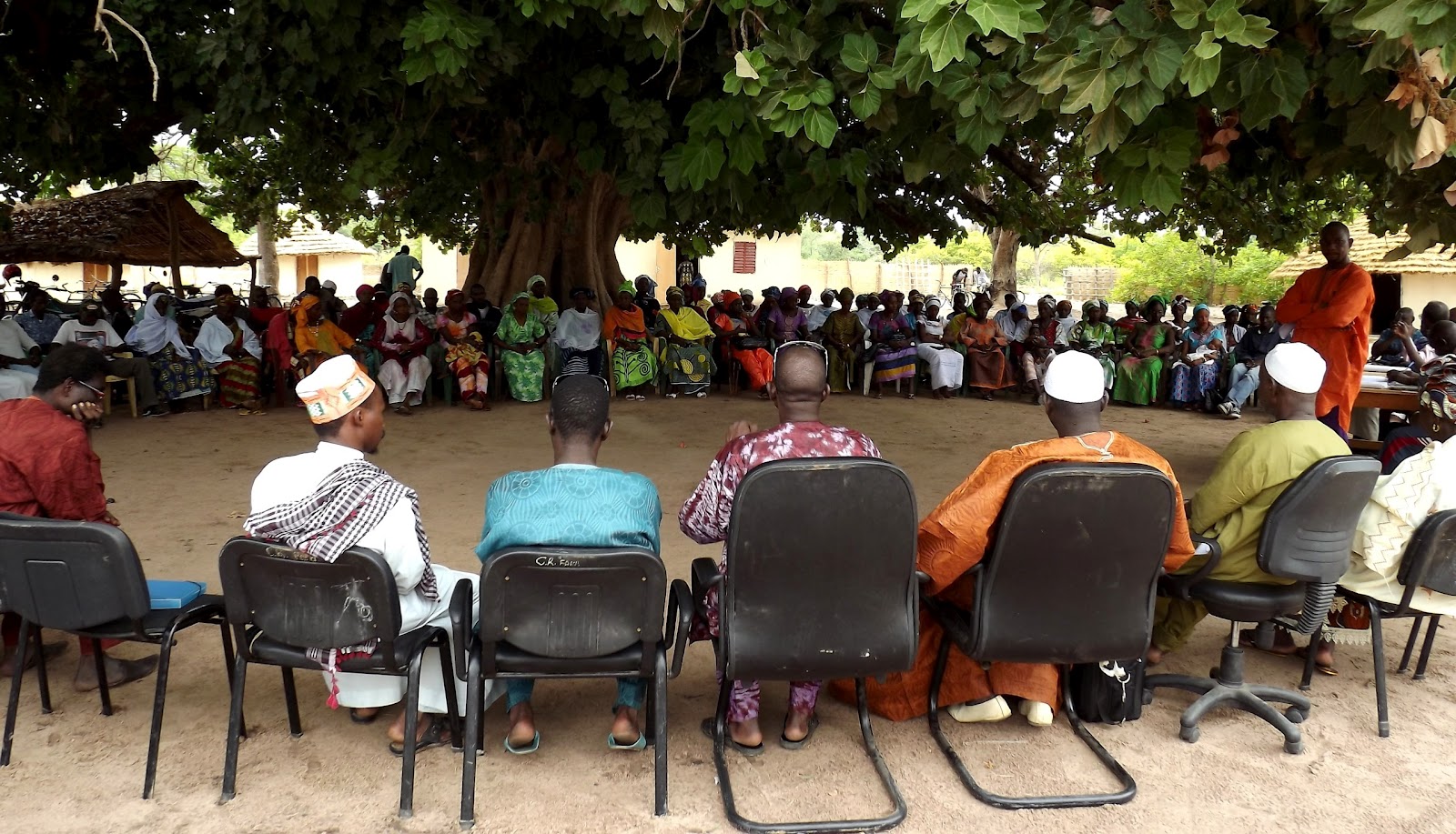
Showing posts with label Tostan. Show all posts

Thursday, February 7, 2013

Tostan FAQ: What is behind the name ‘Tostan’?

Story by Courtney Petersen, Communications Officer in Washington, DC


Tostan is more than just the name of our organization. 
The word ‘tostan’ embodies what we strive to do: to share  knowledge, skills and resources that empower communities to set their own goals and create change on their own terms towards a vision of ‘human dignity for all.
So, what does ‘tostan’ mean?  
Today, our 22nd anniversary, we share what is behind the name! In Wolof, the most widely spoken language in Senegal, Tostan means ‘breakthrough’ (as in the hatching of an egg), as well as ‘spreading and sharing.
This is evidenced in ‘the breakthrough’ experienced by communities when they decide to abandon child marriage after learning about human rights and health, and the spreading and sharing that occurs when they reach out to neighboring communities at inter-village meetings to spread their knew knowledge.’ 
The word ‘tostan’ was suggested to Molly Melching, Tostan’s Founder and Executive Director, by a friend and renowned African scholar, Cheikh Anta Diop. He believed that to foster democracy, development must be educational for all involved, always rooted in and growing out of existing cultural practices and local knowledge. 
Influenced by his philosophy, Tostan, the word and the organization, works within the local context of our participants. Our program begins in African communities with individuals coming together to form a collective vision for their future in which democracy, health, economy, and education thrive. It is through their dedication to learning and sharing knowledge, and putting that into knowledge into practice in order to  achieve their shared vision.
Our human rights-based education program, the Community Empowerment Program (CEP) is offered in 22 (like us today!) languages across eight African countries. Classes are taught in a participatory and respectful manner and include dialogue and consensus building, highly valued skills in African societies. Learners create songs, dances, plays, and poetry inspired from traditional culture to reinforce new knowledge. 
We believe that when participants start with what they already know, they can expand and ‘break through’ to new understandings and practices just as our name says.

Read how Tostan's name inspired one of our former interns, Farba M'Bow, and learn more about Tostan's founding history on our website.

Friday, January 25, 2013

Voices of Tostan: Farba M'Bow


Farba M’bow spent his childhood in Senegal and moved to the United States. His mother, once a participant in Tostan’s Community Empowerment Program (CEP) herself, encouraged Farba to look into jobs within international development. Farba rediscovered Tostan in Washington, DC where he interned as Communications Assistant from September to December 2012. Here, he gives a personal account of his journey and how his experience with Tostan has impacted his life. 

Story by Farba M’Bow, former Tostan Communications Assistant in Washington, DC


Farba and his mother, a former Tostan participant 

When I finished college, I came back home full of ambitions but not truly knowing exactly what the near future had in store for me. I began a manufacturing job still trying to figure out what to do next. Several months later, I joined AmeriCorps where I provided academic support to at-risk youth at a local high school. The experience was great, and I found myself easily interacting with the students, but I still wasn’t sure if I wanted to pursue a career in education. Then one day my mother suggested that I look into international nonprofit organizations after my time with AmeriCorps. I have yet to understand the reason she mentioned this, but it was exactly what I was planning on doing.

A few months later, out of the blue, my mom asked if I could find her the types of reading manuals that she used to study with in Pulaar back in Senegal and suggested that I search for them on the Internet. Well, I knew that the books she read came from an organization called Tostan and I started my search.

I was immediately drawn to Tostan’s website; seeing the incredible work that Tostan was doing in at least eight African countries was so amazing and very appealing. Then later, I discovered that ‘tostan’ was a Wolof word that meant “breakthrough”. Well, I knew what breakthrough meant in English, but I did not recall using ‘tostan’ in any of my Wolof conservations back in Senegal. I asked my mom, who actually speaks better Wolof than Pulaar, but she didn’t know either. I guessed that it had probably been replaced by a French word during the process of colonization. I went ahead and continued searching.

I forgot all about the reading manuals I was asked to look for and started a search of my own. I felt the urgent need to delve deeper into Tostan. I watched every video that I could find and read every article about Tostan. Then one day, I came across a video of Molly Melching explaining the word ‘Tostan’! I listened thoroughly to the point where she explained the meaning of the word as “the hatching of an egg”. Then it hit me! I picked up the phone and explained it to my mother and she went on to say, “Oh yeah, now I remember what that means.”

The analogy of Tostan as “the hatching of an egg” made perfect sense to me. Putting this into context, I knew from personal experience that many women and children hide their opinions because of social and cultural norms and expectations. I was automatically reminded of the example of a girl who gets married at the age of 14 and is forced to live in a confined village of only a couple of hundred people with all the societal and cultural components that come along with this situation. The only way that person can overcome her difficulties and rise above social expectations or ‘hatch out of the egg’ is through education.

My mother hatched out of her own egg in 2000 when she decided to participate in Tostan classes. She had never attended school before. In the Tostan classroom, they started with very basic skills. She went from putting syllables together to reading themes that we could all relate to at home. My four brothers and I were all eager to help. By doing so, we were also able to read in Pulaar, which is something that the school system in Senegal did not teach students. I particularly remember very entertaining and pedagogical animal stories, such as “The Dog and Monkey Wrestling” and another that talked about health and hygiene and ended with the phrase, “When mom and dad are unclean, there is no way they can raise a clean baby.” As children, we found this very funny but also understood it was true.

One thing we did not fully comprehend, however, was just how important the impact that Tostan’s nonformal education program was going to have on our mother. She put everything she learned into practice. She even went on to expand her business by buying dyed cloth from Mali and selling it back to other businesses. A few years after her experience with Tostan, she came up with the incredible idea for us to apply for visas to the United States. As children, we just needed to attend the interviews and within six months, we packed up all our belongings and got on to the plane to the US!

Years later, inspired by my mother’s story, I kept researching Tostan until I found the volunteer and internship opportunities. With a background in political science and women’s studies, everything that Tostan worked on interested me. I was convinced that this was the type of organization in which I could apply what I studied to the real world. On my last day of service with AmeriCorps, I interviewed for the Communications Assistant position with Tostan and received my acceptance within the same week! 

On my first day of orientation, I showed up at the office, rang the bell, adjusted my tie, and patiently waited.  Tostan was everything I expected it to be! The décor on the walls made me think that I was in an actual African community. The pictures of happy looking faces of Tostan participants from African villages automatically reminded me of Tostan’s vision, “Human dignity for all.” I remember thinking that this was the perfect place for me to intern. Everyone at the office was very welcoming. The diversity at Tostan was amazing. From the staff to the interns, everyone spoke another language other than English or had lived in a developing country. I could easily engage in conversation with someone in French, Wolof or Pulaar, and my personal story and that of my mother was well understood.

Working in the Communications Department at Tostan was very rewarding. Every week, we would go over all the activities that Tostan was planning: events, media coverage, and voyages to reach out to the furthest African communities. Tostan’s presence in Senegalese villages that I didn’t even knew existed was proof that community-led development and organized diffusion work. I was stunned to see all the behind-the-scenes activities and the effort, dedication, and cohesiveness the staff contributed so that projects would be completed on time. I was also pleased to discover Tostan’s strategic approaches in terms of changing social norms without harming tradition. Abandoning female genital cutting (FGC); promoting children’s and human rights; establishing social justice; keeping girls, boys, men, and women in school; and reducing domestic violence against women and children in numerous African villages were just some of the momentous results I witnessed while at Tostan. 

I finished my internship very humbled to see all that it takes for an organization like Tostan to educate someone like my mother and thousands more women, men, and children. Leaving Tostan’s office with an invaluable knowledge in nonprofit management will significantly impact my professional career. Hatching from a shell of my own, I will bring with me all that I have learned at Tostan on to my future endeavors.

Wednesday, November 21, 2012

The Community Empowerment Program: Encouraging Environmental Best Practice


Story by Amy Roll, Development and Outreach Assistant, Tostan, Washington, DC 


Mam Kolley moved to the village of Hella Kunda in The Gambia when the community was implementing the Kobi, the second phase of Tostan’s Community Empowerment Program (CEP).
The CEP is a three-year program providing community participants with essential knowledge and skills, setting a foundation for communities to take direct control of their needs and development. 
Originally from Farafenni in the Northern Bank Region of The Gambia, Mam was trained as a Forestry Officer and relocated to Hella Kunda in the Upper River Region (URR). Although she had completed her primary and secondary education, Mam was drawn to Tostan’s CEP and soon became a participant. She realized there was much to gain from the class sessions that championed community-wide participation in activities in Hella Kunda.  
As a Forestry Officer, Mam recognized that the CEP class sessions could help to teach people good environmental practices while taking into account their own culture and traditions. The CEP class sessions are taught in participants’ local languages, and the comprehensive and holistic program covers a range of topics from human rights and health and hygiene to literacy and financial management - creating meaningful dialogue within communities. As Mam says, “the CEP seeks to empower people through the use of their very positive African cultures and in a participatory manner where there is no teacher but rather a facilitator.”  
Mam is invested in The Gambia’s sustainable development and protecting the environment. She sees great value in the CEP for building a foundation on which communities can address development responsibly and learn about their rights and responsibilities to each other and the environment. Mam has conducted awareness-raising sessions on the impacts of littering and the importance of disposing of waste far away from main living areas. She has also taught community members how to make greenhouses and encouraged them to use stoves efficiently in order to decrease the number of trees cut down for firewood. 
Through her participation in Tostan classes, Mam has been able to share best practices that protect the environment and the community. She also now has a forum to mobilize community members to conduct collective action.
Having seen the positive environmental impacts in Hella Kunda, Mam told us that she hopes one day Tostan’s grassroots approach to education will also spread to her hometown of Farafenni.


Wednesday, September 19, 2012

MDG3 in Action: Health and Human Rights


In support of the Global Festival, we will post a story each week during the month of September featuring Tostan's commitment to Millennium Development Goal 3 (MDG3), 'Promoting Gender Equality and Empowering Women' in the series MDG3 in Action.

Join us in the movement to end extreme poverty by becoming a Global Citizen. Watch, view, and share stories on the Global Citizen website to earn tickets to the Global Festival!

Leading Health and Human Rights Initiatives in Sahre Bookar

Story by Anna Vanderkooy, Tostan Projects Assistant, Senegal
Ramatou and her daughter Miriama

Mamadou Ramatou Diallo (Ramatou) lives in Sahre Bookar, Senegal. She is the Coordinator of the Health Commission of Sahre Bookar’s Community Management Committee (CMC). Sahre Bookar formed a CMC when it began Tostan’s Community Empowerment Program in 2010. Composed of up to six commissions (health, environment, child protection, education, income-generating activities, and social mobilisation), the CMC is a 17-member democratically-selected group that organizes awareness-raising events and leads development projects designed by the community. A minimum of nine of the members are women.

In 2011, inspired by the knowledge of health risks and human rights violations gained in Tostan's Community Empowerment Program (CEP), her community of Sahre Bookar held a village-wide meeting to discuss the abandonment of FGC and child/forced marriage. Consensus was reached, as community members confirmed that these two practices harmed the well-being of girls and women in the community. 

Now, as the head of her community's Health Commission, Ramatou is confident that all girls in the community, including her 13-year old daughter Miriama, will benefit greatly from this new respect of their rights. Girls were formerly married as young as 13 to men of their parents' choosing, but today they are assured the right to remain in school and to choose their own husbands after the age of 18. 

Through the Health Commission, Ramatou has organized a number of awareness-raising campaigns in the community related to vaccinations, malaria, and risk reduction during pregnancy. She has seen changes since the arrival of the program, citing that all villagers now sleep under mosquito nets, parents now respect the vaccination calendars set out by the local health post, and expectant mothers attend pre- and post-natal consultations, giving birth at local health centers instead of at home. 

Ramatou also started a health fund, with everyone in the village contributing 100 CFA ($0.25) three times a year. This fund supports health initiatives in the community, giving loans to villagers to assist them in the payment of hospital fees and transportation to appropriate facilities. Next year she hopes to use money from this fund, along with support from the local health post, to start a health closet that will ensure access to basic medication in Sahre Bookar.

With her knowledge and skills gained from the Tostan program, Ramatou has been empowered to play a leadership role in her region of Senegal, striving for better health and well-being for Sahre Bookar and surrounding communities. 

Wednesday, September 12, 2012

MDG3 in Action: The Prison Project

Story by Keala McConnon, Tostan Prison Project Volunteer, Senegal

Mame Diarra with her husband at their home in The Gambia.

Tostan implements a modified version of its holistic non-formal education program, the Community Empowerment Program (CEP), in five Senegalese prisons. The ‘Prison Project’ aims to help detainees recover their sense of human dignity through participation in the CEP and learning about their human rights and equipping them with practical skills to start income-generating activities. Tostan also facilitates family mediations to help integrate former detainees back into their communities.

The majority of participants in the five prisons where Tostan works are women. One of the most visible results of the Prison Project is the economic empowerment of women due to their newly acquired skills in income-generating activities. These activities include fabric dyeing, soap making, juice making, aviculture, and more. The prisons where Tostan works have also linked practical skills trainings to the reduction in rates of re-offending.

Trainings on income-generating activities are very important as they can help detainees become financially self-sufficient during and after their imprisonment. A detainee’s ability to provide for herself is essential to successful re-integration into society. Gained skills also provide detainees the possibility of generating income while incarcerated, which increases their ability to purchase additional food, hygiene items, such as soap and toothpaste, and medication.

Mame Diarra Ndiaye is one woman who has benefited from Tostan’s CEP and income-generating trainings.

Mame Diarra is from The Gambia but travelled to Senegal for employment as a domestic worker. She was imprisoned shortly after her arrival in Senegal and sentenced to five years in prison. Due to her commitment to the CEP and good behavior, she was released within three years. 

After her release in 2011, Mame Diarra returned to The Gambia where she put her new skills in fabric dying and juice making to use. She has been using the skills she gained with Tostan to make a living since her release.  Mame Diarra is also training other women in her neighborhood in the skills she has learned, especially juice making skills, which are particularly useful because of The Gambia’s abundance of fruit.

Tostan’s Prison Project empowers some of the most vulnerable people in Senegalese society and around the world: female detainees.

To learn more about how the Prison Project empowers women in Senegal, read our blog about International Women’s Day and watch the video, “Empowered Women Take Charge of Their Freedom Together at Senegalese Prison.” 


Friday, August 31, 2012

Show your support for Gender Equality by becoming a Global Citizen!


From Alisa Hamilton, Tostan Communications Assistant in Dakar, Senegal


Throughout the month of September, Tostan will be supporting the Global Festival and the Global Citizen campaign in partnership with Half the Sky. We will collaborate with amazing organizations around the world to raise awareness about the Millennium Development Goals (MDGs) in the movement to end extreme poverty.

As a member of the Half the Sky coalition, Tostan will focus primarily on raising awareness about Millennium Development Goal 3, Promote Gender Equality and Empower Women. We will feature photo essays, videos, portraits, and articles all relating to gender equality on our blog and on the Global Citizen website. Also make sure you follow our social media channels (Twitter, Facebook, Flickr, Youtube) for links to amazing stories about female leaders and community-led development in West and East Africa.


The Global Festival is a concert being held in New York City on September 29, 2012 hosted by the Global Poverty Project. It will bring together artists and change-makers to end extreme poverty and is taking place the same week that world leaders gather in New York City for the UN General Assembly. 

At the concert, Tostan will be among a number of other organizations that will announce a new commitment to raise funds to help end extreme poverty. The exact announcements will remain secret until the day of the concert, but you can find out more about the concert and how to attend below!

Tickets to the Global Festival are free, but the only way to win them is by becoming a Global Citizen and earning points on the Global Citizen website. Earning points is easy! All you have to do is view, watch, and share media from the partnering organizations through the website.

Becoming a Global Citizen is also a great way to spread awareness about the issues that you are passionate about to your friends. This is easy to do through the website as well and also earns you points.

We at Tostan are incredibly excited about the opportunity to support this movement and encourage you to get involved as well. Become a Global Citizen in support of Gender Equality today!

Check out this video by partner Half the Sky!


Wednesday, August 22, 2012

VOICES OF TOSTAN: Fatoumata Sumareh

Sixteen year-old Fatoumata Sumareh was born in the community of Touba Sandu in the Upper River Region (URR) of The Gambia, where she lives with her mother and father and her younger siblings. Fatoumata participates in Tostan’s Community Empowerment Program (CEP), which began in her village in the spring of 2011. In this interview with Elizabeth Loveday, Tostan Project Assistant in The Gambia, Fatoumata describes how her participation with Tostan has changed her everyday experience and goals for the future.

Story and photographs by Lilli Loveday, Project Assistant, The Gambia

Fatoumata Sumareh

Fatoumata is a keen participant in Tostan’s CEP class sessions. She was inspired to join the program because of her desire to further her knowledge about themes in the CEP, such as human rights, health, literacy, and project management. In early 2012, her community completed the second phase of the CEP, the Kobi, which focuses on hygiene and health. As a result of learning about health and hygiene, many communities organize village clean-up days and promote hand washing and clean food preparation. These class sessions were of particular interest to Fatoumata:

"Tostan has strengthened our community’s awareness of why it is important to have a clean environment. We have learned that if you do not have a clean living environment you cannot be free from diseases and you cannot be healthy. I think understanding that is really important."

In addition to attending Tostan classes, Fatoumata is currently enrolled in Grade five of the Koranic school in a nearby village. “I enjoy this education and I love to learn! I want to learn everything I can.’’ Fatoumata is dedicated to her studies both with Tostan and at the Koranic school and has strong ambitions to take her education to the highest level: “In the future I would like to be somebody who is very educated. I would like to be a doctor.’’

Fatoumata’s parents approached her about marriage in 2011. She said: "They proposed marriage to me once… but I want to get married at 18 or above, I do not want to get married before that because I am not ready."

Through the CEP class sessions on human rights and health, parents are encouraged to let their children chose their spouses after they turn 18 and are educated on child protection and the harmful consequences of early pregnancy. Fatoumata’s parents respected her decision. Reduced rates of child/forced marriage have been some of the most prominent and visible results of the Tostan program.

Now that the village of Touba Sandu has completed the Kobi, it will begin the final phase of the CEP, the Aawde. The Aawde focuses on functional literacy in national languages and project management. Fatoumata is looking forward to learning how to read and write in Mandinka. At the moment, she is only literate in Arabic. 

Speaking with great confidence about her ambitions for the future and becoming a doctor, 16 year old Fatoumata is excited about participating in the Aawde and using her knowledge and skills to reach her goals and improve the well-being of her family and community. 


Friday, August 3, 2012

The Elders Bring Attention to Child/Forced Marriage in The Washington Post

Article by Courtney Petersen, Communications Officer in Washington DC.

CEP participants at the 3rd Annual Youth Caravan in The Gambia.
On July 31st, two founding members of The Elders, Graça Machel and Desmond Tutu, brought much needed attention to the global issue of child/forced marriage. Writing in The Washington Post, they called for urgent action saying: “At current rates, 100 million girls will marry as children in the next decade.”


They illustrate the inseparable link between child/forced marriage and the continuance of poverty - when a girl is married too young she is much more likely to drop out of school, experience health complications during childbirth, and can be vulnerable to domestic violence. If she is able to stay in school, she is less likely to experience these negative consequences and more likely to be able to contribute to her community and society at her full potential.

Graça Machel and Desmond Tutu also talk about the hope that exists for many girls worldwide who once faced this stark reality, saying that child/forced marriage no longer has to be an obstacle in their development. Specifically, they mention the transformation that is being led by communities in Senegal - thousands of communities joining together to declare their decision to abandon the practice of child/forced marriage. Many of these communities are direct participants of Tostan’s human rights-based Community Empowerment Program (CEP). 

Though positive change is occurring, The Elders reiterate that we all must continue to build momentum for this movement.  By working with communities in Africa and around the world; gaining support from local and national governments; and collaborating with international organizations like The Elders and our partner Girls Not Brides, we hope that the decline of child/forced marriage will only accelerate.


Friday, July 20, 2012

VOICES OF TOSTAN: Stephen Allen

An organization is nothing without the passion and dedication of the team of individuals behind it. Tostan is comprised of talented, committed people ranging from village elders to directors, Community Empowerment Program facilitators and participants to volunteers and interns. Each individual contributes his or her unique personality and skills to further the work of Tostan, thus creating a dynamic environment in which positive change can take place.

We highlight the diversity of interests, talents, and backgrounds within the Tostan team here on the blog in a series entitled Voices of Tostan. Specifically, we will explore what brought each unique voice to Tostan and why Tostan’s efforts to bring about positive social change are significant and meaningful to each individual.

Story by Stephen Allen, MERL Volunteer, Thiès, Senegal

Stephen (bottom right in green) with members of the MERL team, supervisors, and a facilitator.

Arriving in Senegal the first week of June to begin one year of volunteering with Tostan, I was eager to begin my work in the Monitoring, Research, Evaluation, and Learning (MERL) Department in the Senegal National Coordination in Thiès. 

As the name indicates, the MERL Department is responsible for designing data collection tools and carrying out monitoring and evaluations in the communities where Tostan projects are implemented. Tostan uses these reports to feed back to donors, to tell the stories of Tostan’s work from the field and for Tostan’s own continuous improvement of its programs. The MERL Department is able to accomplish its mission partly through organizing field missions to communities at key phases of project implementation in order to complete surveys and monitoring reports. 

When, during my second week, I received the news that I would be accompanying one such mission to ten communities, I was delighted to be able to accompany a field mission so early on in my time in Senegal. 

Bag packed, I headed out with the MERL team to the regions of Kaolack and Kaffrine, just north of The Gambia, for a twelve-day, ten-community final evaluation mission. 

The communities that participated in the evaluation were Pulaar, an ethnic group that represents a minority in every country in which they live but which extends from West Africa all the way to Chad and parts of Sudan. Having just completed Tostan’s Community Empowerment Program (CEP)—a three-year participatory education program that teaches hygiene, health, literacy, and project management, all with a focus on human rights—the ten communities were eager to share their successes with the MERL team. At Néty Dagga, participants from the adolescent Tostan class could be heard all morning reciting Pulaar songs that their facilitator had taught them to help learn the steps of conflict resolution. While at Galoulé, the women insisted we look at the soaps they had produced themselves for sale as an income-generating activity, using their newly acquired management skills. 

Children and adolescent participants in the village of Médina Torodo perform a song.

Tostan regional supervisors, themselves of Pulaar origin, carried out the surveys and interviews for the evaluations conducted in each village. I had the opportunity to sit in on interviews with each village’s Community Management Committee (CMC). A CMC is a seventeen-member, democratically selected committee that is put in place when a community is implementing Tostan’s CEP. The committee is charged with putting the skills acquired through the Tostan program into practice by encouraging active community involvement through democratic participation and long-term sustainable development

Being able to see in person what the other new volunteers and I had just discussed during our volunteer orientation was extraordinary.  I met so many CMC members who were so committed to the development of their communities.  
Over those twelve days, I was able to learn an incredible amount about the Monitoring and Evaluation Department, Tostan’s Community Empowerment Program (CEP), monitoring and evaluation techniques, and the Pulaar people’s wonderful history and traditions. 

My personal observations from the field have been indispensible in helping me to write reports for the evaluation. In all, I had an amazing and educational two weeks—what a way to begin my year with Tostan! 


Wednesday, July 18, 2012

Melinda Gates Visits Empowered Community Members in Senegal


Molly Melching, Tostan Executive Director, explains to Melinda Gates how Tostan teaches cell phones with the metaphor of a mango tree.

On Sunday 8th July, the community of Kolma Peulh warmly welcomed a special visitor.

Melinda Gates of the
Bill & Melinda Gates Foundation visited this small rural village in the Kaolack region of Senegal, West Africa on her way to London where she opened the Family Planning Summit 2012.

Ms. Gates spent three hours with women, men, and children of Kolma Peulh discussing the impact that empowering basic education can have on improving women’s health, particularly in the areas of family planning, female genital cutting(FGC), and child/forced marriage.

Throughout the visit, women confidently spoke out about these formerly taboo issues and explained how they had negotiated deep social change with their husbands, religious leaders, and neighboring communities, creating a broad consensus to end practices harmful to their health and that of their children. Community members from Kolma Peulh and neighboring villages are participating in the Tostan Community Empowerment Program (CEP), a three-year non-formal education program in national languages developed for those who have little or no access to formal schooling.

Ms. Gates was particularly interested in learning how social norms affect communities’ attitudes and behaviors and how the CEP provides a holistic framework for all community members to address issues on their own terms.

One man commented that when he learned about the negative consequences of women having children year after year he was keen to begin birth spacing in his own family. "Before we were nearsighted. Nearsightedness of the eyes is bad, but nearsightedness of the heart is worse. We have now adopted practices that we know will lead to better health for women and children in the community and have ended practices that don’t. In the past, we felt we could never question traditional beliefs and didn’t have the right information and social support to change."


Tostan Executive Director Molly Melching noted that the visit was well received by all involved.  “Tostan’s work is community-led and all of us at Tostan were thrilled that the people of Kolma Peulh had the opportunity to share their accomplishments, passion, and vision for the future with Ms. Gates, directly through an extended, open dialogue."

Friday, July 6, 2012

Discussing the Abandonment of FGC and Child/forced Marriage in Kolda

Story and photographs by Angela Rowe, Tostan Regional Volunteer in Kolda, Senegal

Participants at the two-day Tostan workshop in Fafacouru.
Sixty villages in southern Senegal have just completed Tostan’s Community Empowerment Program (CEP).  The villages in the department of Medina Yoro Foulah have spent the last three years working with Tostan to increase literacy and local engagement in projects centered on education, health, hygiene, human rights, and democracy.

Topics such as female genital cutting (FGC) and child/forced marriage are discussed at the community level through participation in the program.

A woman participant works with her
group to generate ideas for handling
violence at the community level.
On June 25th and 26th, Tostan held a two-day workshop in Fafacouru to discuss human rights and democracy and community-led initiatives to end FGC and child/forced marriage.  This workshop was attended by over 150 people, including Tostan staff, program participants from eight different villages, Community Management Committee (CMC) members, NGO partners, and other local leaders.


The workshop began with Mamoudou Camara, Assistant Coordinator of Tostan Kolda, asking the participants to share their expectations for the workshop.  Together the community discussed their desire to further understand Tostan’s strategy and program, to discuss the importance of human rights in regards to both positive and negative social norms, and finally, to generate a sense of community involvement for the abandonment of FGC.  The workshop consisted of presentations regarding Tostan’s values and mission, program implementation and subsequent results. Participants were encouraged to ask questions and share their thoughts with the group, several of whom cited Tostan’s CEP as being an essential component to creating positive social change in their own communities.

One inspiring part of the workshop was when a Tostan presentation on human rights prompted a lively and impassioned dialogue among the participants.  In small groups, community members discussed the types of violence and discrimination they had personally witnessed or experienced, and subsequently generated ideas of how to handle these situations should they arise again in the future.  The recognition of basic human rights, they concluded, was the first step in confronting negative social norms.  After sharing and presentation sessions, the conversation naturally unfolded into a reflection on one of the most sensitive community issues: FGC.

Imam of Fafacouru speaks out
about the harmful consequences of FGC.
FGC, a practice once viewed by many to be an essential piece of traditional culture, can result in higher rates of maternal and infant mortality, fistulas, and other serious health problems for girls and women. After three years of non-formal education, participants were able to participate in open dialogue about these issues and come to a decision together around the necessity to abandon the practice.

At the end of the workshop, Tostan was asked to further extend their program into surrounding villages.  The department of Medina Yoro Foulah hopes that through the process, all its villages will soon declare total abandonment of both FGC and child/forced marriage.

Though the education about human rights through Tostan’s CEP was certainly a catalyst for change, as demonstrated through the workshop and by people coming together to discuss these issues, the most powerful and sustainable forms of social change come from the communities themselves.


Monday, June 25, 2012

Outstanding Supporter: Spreading Awareness through Artwork


Story by Kate Brendel, Tostan Development Assistant in Washington, DC

Musician and long-time Tostan supporter, Karien de Waal, used her artistic talents to creatively raise awareness and support for Tostan’s mission. By means of a year-long art project that collected the faces and signatures of numerous celebrities, Karien hopes to not only raise money to support Tostan’s programs, but also to get her community as excited about Tostan’s work as she is.

The Women of the World displaying Karien's drawing.
Based out of Berklee College of Music in Boston, Massachusetts, Karien has had many opportunities to interact with world-renowned musicians who regularly come to her school to perform.  Hoping to do something to garner support for Tostan within her community, she began drawing these celebrities as they visited the Berklee campus and had them autograph her canvas. “The idea was to get as many famous people to sign on one canvas as possible,” said Karien. Signatures on Karien’s canvas include such musicians as Chucho Valdes, John Mayer, Emilio and Gloria Estefan, India Arie, The Eagles, and many more.

Taking her outreach one step further, Karien contacted many of the musicians she had drawn to tell them about her project and about Tostan’s work. “I decided that for each celebrity that I drew, I would write them a letter to tell them about [female genital cutting] FGC and the positive work Tostan does through education. I kept it in the tone of your organization, focusing on the solution, rather than the problem.”

Chucho Valdes adding his signature to the canvas.
Now that her masterpiece is complete, Karien’s goal is for this canvas to be auctioned off, with the proceeds directly benefiting Tostan.

In addition to creating the drawing, Karien also hosted an art exhibit at a local coffee shop, Pavement. Confident that this exhibit would gain lots of attention, she created a poster and distributed media materials, including an introductory video about Tostan. “Pavement is the most popular coffee shop on the block and I wouldn't be surprised if around 4,000 customers go through there a week.” At the end of the three-day exhibit, all 50 copies of the DVD had been taken, and word of Karien’s mission was quickly spreading throughout the community.

Although her canvas is finished, Karien’s mission to spread awareness of Tostan is certainly not over. She has numerous plans for future projects that will incorporate her many talents as a musician, artist, and community supporter. “I can get people to buy into the cause to make a positive change,” explained Karien, “because I truly believe in your work.”

Karien's artwork will be auctioned off to benefit Tostan. To find out more information, contact Elizabeth at info@tostan.org.


Friday, June 22, 2012

Former detainee returns to Senegalese prison to train women in income-generating skills

Story by Kaela McConnon, Prison Project Volunteer; Photos by Aïssatou Kebé, Prison Project Supervisor, Tostan

In May of this year, thirty-two women participated in a ten-day training on traditional fabric dyeing.  This wasn’t your traditional fabric dyeing workshop as it was conducted in a prison in Thiès, Senegal, by a former detainee who had gone through Tostan’s Community Empowerment Program (CEP). 

Awa Fall has used her fabric dyeing skills to reintegrate successfully into her family and community since her release from prison. She conducted the training for the participants at Thiès prison, thirty of which were female prisoners and two were female guards.  Tostan provided all necessary materials for the training and at the end of the ten days, participants were already able to produce pieces of fabric to sell.  After their release, they will be able to use these skills to provide themselves with an income.

Awa Fall with fabric produced during the training.
Awa Fall, spent four years in the same prison herself, during which time she took part in Tostan’s CEP, a non-formal three-year education program that covers essential topics including human rights, problem-solving, health, literacy, basic mathematics, income-generating skills, and project management.  She also took part in three trainings on fabric dyeing in 2003, 2004, and 2005, mastering the skills that would become her means of economic empowerment and successful reintegration. 

Awa was able to start fabric dyeing activities and training to become a fabric dyeing teacher with the help of a 50,000 CFA (approximately $100) contribution from Tostan. Tostan’s Prison Project team also facilitated a family mediation when she was released from prison, encouraging her family to accept and support her.  She has since been able to support herself financially and is now married and contributes financially to her family.  Her skills and experience as an ex-detainee made her the perfect candidate to teach these women new skills, and she helped make the workshop a success for all involved.     

The workshop participants spent much of the ten days engaged in the practical tasks of preparing, dyeing, and drying of the fabric.  Being taught by a former detainee who has since used these skills to help reintegrate back into society very successfully, really resonated with the participants.  Feedback from them on completion of the workshop was that ten days was not long enough and further trainings on income-generating activities should be twenty days instead! 

A detainee’s ability to provide for herself is essential to successful reintegration into society.  Families and communities often are unwilling to accept former prisoners back into their lives, not only because of the social stigma that imprisonment brings, but also because they may require further financial commitment which is an additional pressure on the family and community. 

Fabric produced by detainees during the ten-day training.
Learning income-generating skills can help solve this, and it gives the former detainee the opportunity to contribute to their family and community, further encouraging social acceptance and a feeling of worth. 

The Prison Project team is planning a small fair in the coming weeks that will allow for the display and sale of the products produced during this training. The goal of the fair is to provide economic means for participants while in prison and for when they are released.  It will also help demonstrate the economic potential of their new skills to the detainees, as well as raise awareness of this project with communities. 

Income-generating trainings will continue throughout 2012: another on fabric dyeing, one on soap making, and three planned on the production and storing of important grains that provide an essential food source for Senegalese communities. We hope that these trainings will continue to empower women financially, such as trainer and former detainee Awa Fall, and help them reintegrate back into their communities following imprisonment.

Click here to read more about income-generating workshops by the Prison Project team.

Friday, May 11, 2012

NEW VIDEO: Tostan's Peace and Security Project Launch


This video of Tostan's Peace and Security Project launch, made by Dakar Communications Assistant Alisa Hamilton, highlights the perspectives of Odile Tening, Project Manager at Gorée Institute; Mory Camara, Tostan Peace and Security Project Director; and Abdoulaye Kandé, Tostan Regional Coordinator of Kolda. Held on April 22nd in the village of Tankanto Maoundé in the department of Kolda, Senegal, the project launch featured speeches, songs, and plays promoting human rights and its important role in achieving peace and security.

To read more about Tostan's Peace and Security Project and the project launch, click here.


To watch more videos featuring Tostan's work in Africa, check out our YouTube channel here.

Tuesday, May 8, 2012

"African Heat": Communities Bridge Boundaries at Peace and Security Project Launch

Story and photographs by Alisa Hamilton, Tostan Communications Assistant in Dakar, Senegal

“I learned a lot of things. I saw very dynamic communities. I saw communities who have not forgotten where they come from because they resolve problems using solutions from their own culture."
                          -Odile Tending, Program Manager at Gorée Institute  


Women from Tankanto Maoundé dance with
the image Tostan uses to represent
the right to peace and security.
On April 22, 2012, Tostan launched its Peace and Security Project in the village of Tankato Maoundé in the department of Kolda, Senegal. Funded by the Swedish International Development Agency (Sida), this project aims to address issues of peace and security in West Africa by connecting grassroots communities and their social networks with regional and international institutions. With this increased collaboration, regions, and nations as a whole, can work together to identify barriers to the peace and security of their area and create solutions that will overcome those barriers. Tankato Maoundé community members and Tostan delegations from The Gambia and Senegal participated in the event alongside project partners* and donors. The celebration included speeches, songs, and plays promoting human rights and its important role in achieving peace and security.

Abdoulaye Kandé, Tostan Regional Coordinator of Kolda, described Tankato Maoundé as a very “dynamic” community. He remarked, “We’ve noticed this since the implementation of the [Community Empowerment Program].” Abdoulaye was proud to host the event in his district: “The Peace and Security Project is very important in Senegal.” “Beside us [in southern Senegal], there is The Gambia, Guinea-Bissau, Guinea, and Mauritania. I think that [the project] must begin in Kolda in order for there to be peace in this region,” he concluded with a smile.

Awa Ballé Cissé of Sedhiou, Senegal presents
the right to health: “Health has no borders."
During the Kolda delegation’s presentation on human rights, Community Management Committee (CMC) member Awa Ballé Cissé from Sedhiou emphasized that “health has no borders.” Sedhiou’s CMC leads awareness-raising campaigns on family planning and vaccination in their village and throughout the region. “We went all the way to The Gambia to raise awareness,” she proudly shared while holding up the image Tostan uses to represent the right to health. She continued, “We must work hand in hand to achieve our objectives.”

The Peace and Security Project focuses on building ways to overcome barriers that limit an individual’s ability to develop, for example barriers to learning. “Education has no age,” stated the CMC Coordinator Abdoulaye Kebé from the village of Karsia. Karsia’s CMC has continued literacy and numeracy initiatives in their community even after the completion of the CEP and actively encourages the participation of all ages. They also work hard to improve the conditions of schools. By collaborating with local marabouts or religious leaders to improve the conditions of daaras (koranic schools), Karsia’s CMC demonstrates that education has no age or religion.
Tostan Executive Director, Molly Melching (left),
presents the human rights booklet to the
community, project partners, and
local government officials.

During the presentation on human rights, the Kolda delegation emphasized the importance of health and education in peace and security. “Today we must first think about health and education,” proclaimed Sowa Baldé of Kolda. Her community has created committees responsible for resolving conflicts peacefully. “We cannot have peace and security without health and education,” she concluded. Her final comment illustrates the importance of a holistic, human rights approach in achieving peace and security. Individuals must understand their fundamental rights, such as the rights to health and education, before communities, regions, and finally countries can respect them. Tostan’s Peace and Security Project is unique because, unlike many policy and government focused programs, its approach begins at the community level with discussions on these very topics. 

Illustrating the importance of bridging gaps between donor agencies and field work—a main goal of the Peace and Security Project—representatives from Sida also partook in the day’s festivities. Jonas Bergström, Sida Program Manager, summed up the project’s collective efforts to bridge countries, ages, religions, and ethnic groups in his closing words to the community:
“We come from a very cold place and what we have learned from Africa is the African heat. This heat is turned into energy and is capable of changing the world. I am confident that the people here along with organizations like Tostan can change today into a better tomorrow.”

To view a full photo album from the Peace and Security Project launch, click here.

To watch video footage and interviews from the event, click here.

To read this article in French of Tostan France's website, click here.
----- 
*Project partners present included The Gorée Institue, Alliance of Migration, Leadership and Development (AMLD), African Center for the Constructive Resolution of Disputes (ACCORD), Femme Africa Solidarité (FAS), West African Network for Peacebuilding (WANEP), Network of Peace and Security for Women in the ECOWAS Region (NOPSWECO)
 
Blog adapted by Salim Drame