Showing posts with label female genital cutting (FGC). Show all posts

Friday, April 19, 2013

Using social mobilization techniques to grow the movement for the abandonment of female genital cutting

This post originally appeared on Orchid Project's blog on April 17, 2013 and is reproduced with Orchid Project's permission. To view the original post on the Orchid blog, click here

Story by Allyson Fritz, Tostan

When looking at the number of villages who have decided to abandon FGC, over 5,500 in Senegal alone, it’s easy to forget just how difficult it is to shift this social norm. In many villages in Senegal, as in other countries, female genital cutting (FGC) is a tradition deeply embedded in the culture. Communities that practise FGC may think it is important because it has been done for as long as they can remember, or they may be subject to the misconception that it is a requirement of Islam.

Tostan social mobilization teams address concerns like these in a respectful manner while sharing information on the harmful effects of FGC and, specifically, how other communities in their social networks are choosing to abandon. In partnership with the Orchid Project, the social mobilization team based in the Kolda region of Senegal conducts a 12-day long visit to multiple communities every month. Their goal is to share information and facilitate discussions in communities about human rights and the harmful traditional practice of FGC, as well as the growing movement to abandon the practice.

Through this dialogue, communities are able to discuss the harmful consequences of FGC and why other communities like their own are abandoning the practice. Collectively, they are then able to decide for themselves if they want their community to join others in abandoning.  At times this process can be rapid, but most often it occurs slowly as communities build their understanding of human rights and how the practice of FGC hinders the development of their community.   

When the team works with a community, they start by spending the first day with key members of the village, including the village chief, imam, president of the women’s group, school director, elected representatives, and president of the youth group.  They introduce themselves and inquire as to whether or not they may conduct a village meeting the following day at a time convenient for the village. If the village agrees, the team will spend the night in the village and facilitate the meeting the following day.

It is critical to get the support and approval of these persons of authority before beginning any meetings with the rest of the community. They are respected voices within their communities and without their consent, it would be very difficult for the team to gather the community and share their knowledge, experiences and information.

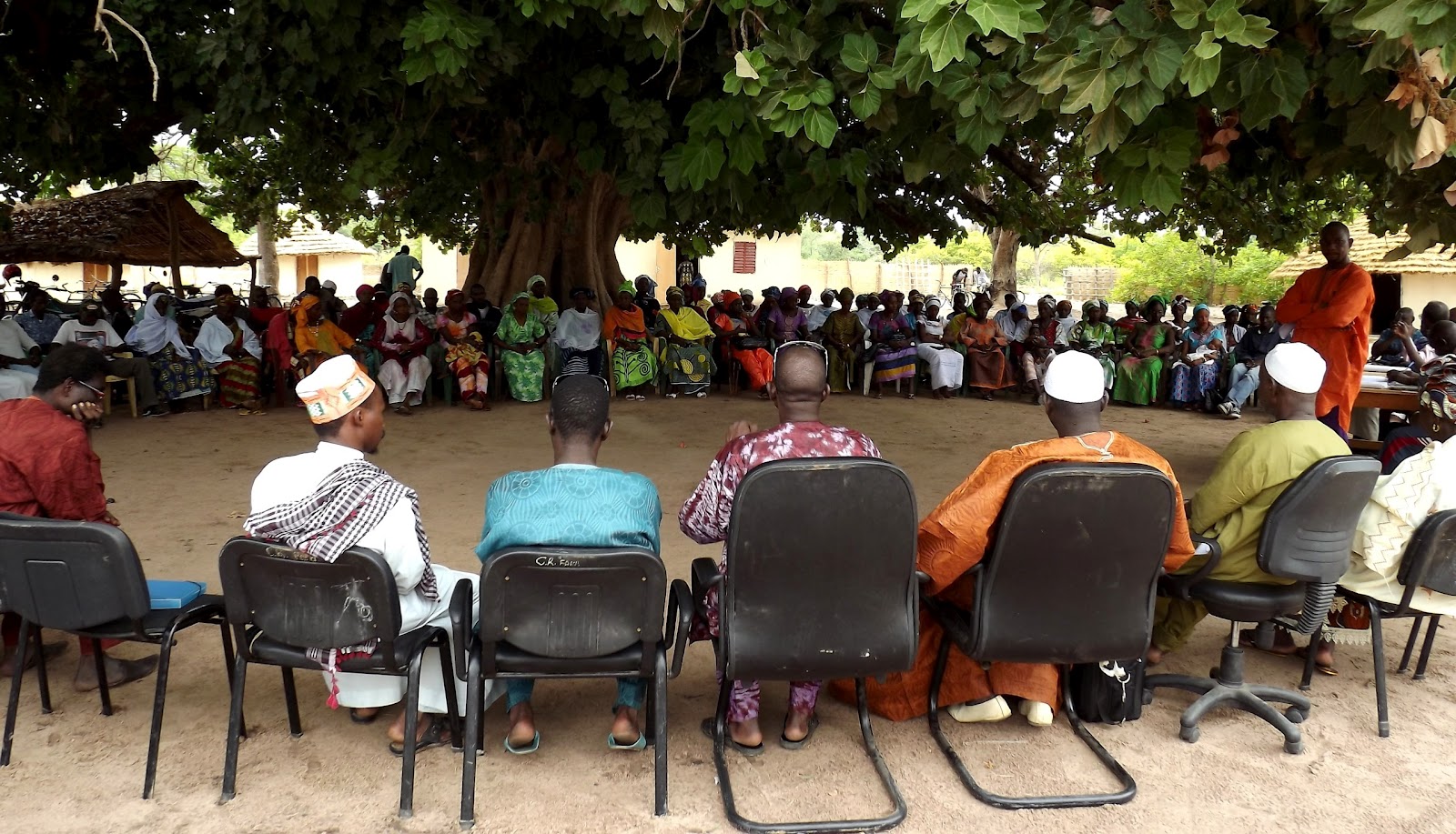
At the appointed time on the second day of the team’s stay in a village, the meeting is convened and everyone is invited to participate. The team structures the meetings so that they start out with general information and slowly move into more sensitive topics.  The rationale behind this is that if the team jumps right into discussing FGC, which has been a taboo subject for so long, the community may be hesitant to share because they do not know the team or their purpose.

By transitioning slowly from talking about human rights, specifically those rights of women and children, and moving into violence committed against women and eventually FGC, the community is able to get a sense of who these agents are and what they are trying to accomplish. They are then more likely to feel comfortable enough to engage in a dialogue.

Thursday, February 28, 2013

NEW PHOTOS: Public Declaration in Fafacourou, Senegal

On Sunday February 24, 2013, 128 communities publicly declared their abandonment of female genital cutting (FGC) and child/forced marriage in the village of Fafacourou in the Kolda region of southern Senegal. 

Learn more about the declaration and check out the photographs taken by Tostan Volunteers, Meagan Byrne and Allyson Fritz!


Local children put on a skit, organized by Tostan Supervisor Oumar Pam, discussing the problems associated with FGC and child/forced marriage. Photograph by Meagan Byrne, Tostan.

Audience members from the declaring villages watch as local children perform a skit about the dangers of FGC and child/forced marriage. Photograph by Allyson Fritz, Tostan.
While the declaration text was being read in three languages, French, Soninke, and Pulaar, representatives from each of the 128 declaring villages stood in a group, holding up signs with their village names. Photograph by Meagan Byrne, Tostan.


Aissatou Diallo, a student from the village of Fafacourou, reads the declaration text. Photograph by Meagan Byrne, Tostan.

Mouhamadou Gano, journalist for Agence France Presse, acts as master of ceremonies for the declaration, introducing speakers and cultural acts. Photograph by Allyson Fritz, Tostan.

View more photos from the Fafacourou declaration in our Flickr photostream!


Friday, February 15, 2013

Sharing Tostan's Grassroots Approach with Policy Makers in Washington, DC

On February 6th and 7th, Bacary Tamba, the Tostan National Coordinator of the Diaspora and Regional Coordinator of Ziguinchor, presented at two panel discussions in the United States as a featured speaker. 

Bacary illustrated the process of community-led social norm change using the recent example of his role in organizing Senegal’s first regional declaration in Ziguinchor, with 427 communities publicly declaring their abandonment of FCG.

Read more about the panel discussions and briefings that Bacary attended on our website and watch the video of the declaration below.


Monday, January 28, 2013

The Social Mobilization Team of Sédhiou, Senegal plans to make an impact on FGC abandonment in their region

Article by Angie Rowe, Tostan Volunteer in Kolda, Senegal


What is the key to mobilizing entire social networks around the promotion of human rights? The answer is to utilize the greatest and most effective advocates for positive change: passionate community members themselves, social mobilization agents. 
Social mobilization is organized information-sharing through awareness-raising campaigns and activities.  In villages who are participating in Tostan’s Community Empowerment Program (CEP), teams of social mobilization agents are created to extend the reach of knowledge shared in CEP classes. This ensures that entire networks of people are informed and feel a part of any decision to promote positive social change in their area. Social mobilization teams also organize inter-village meetings to discuss important issues and achieve consensus on decisions affecting the extended social network.
As part of our continuing partnership with Orchid Project, two social mobilization teams were created in Kolda and Sédhiou in southern Senegal to lead awareness-raising activities that will engage neighboring communities around human rights and accelerate the movement for female genital cutting (FGC) abandonment in regions where rates are the highest. Read more about this social mobilization project in a great article on Orchid Project's blog. 
Each team consists of a supervisor and five social mobilization agents specifically selected for their skills in communication and their dedication to positive social change. We introduced Kolda’s social mobilization team last week, and now we are glad to introduce to you the social mobilization team of Sédhiou, Senegal! 

Abdoulaye Kebe, Supervisor, Sédhiou

Abdoulaye works for Tostan because he strongly believes in the promotion of human rights and the preservation of human dignity. Excited to be a part of this new project, he hopes to use his previous experience with social mobilization activities to support positive behavioral change in villages throughout Sédhiou. Outside of work Abdoulaye enjoys reading the Koran and tending his garden.  

Mariama Doumboya, Social Mobilization Agency (SMA), Sédhiou
In the past, Mariama worked for Tostan as a Community Empowerment Program (CEP) facilitator in Sédhiou, where she focused specifically on social mobilization activities. She continues to work with Tostan to increase her knowledge of human rights and health and share that knowledge with communities. In her free time, Mariama loves to cook—especially dishes with couscous. 
Mamadou Sao, SMA, Sédhio
Mamadou was born and raised in Sédhiou and is very passionate about improving the well-being of people in his region. He is particularly interested in helping to bring an end to violence against women and children. He hopes that as a member of the social mobilization team he can provide information to villagers, encouraging them to abandon harmful practices such as female genital cutting (FGC), child/forced marriage, and early pregnancy. Outside of work he enjoys playing soccer, scrabble, and reading.
 
Seydi Bouba, SMA, Sédhiou
Seydi is an advocate for education rights and enjoys working for Tostan as its program makes nonformal education accessible to community members. He is interested in working with Orchid Project because its goal aligns closely with something he is passionate about: the abandonment of FGC. He hopes to use his skills to inform people of the harmful consequences of FGC and child/forced marriage throughout the duration of this project. Outside of work he enjoys farming and other agricultural activities.  
Mouskeba Konte, SMA, Sédhiou
Born in Sédhiou, Mouskeba has always felt passionate about health issues in her community. She was happy to find work that supported her beliefs and hopes that the work of Tostan will further develop her country positively. She is excited to be part of the social mobilization team where she can use her knowledge and experience to prompt meaningful discussion in local communities.  She hopes this work will eventually lead to total abandonment of FGC in Senegal. Although Mouskeba is kept busy as a member of the social mobilization team, she always makes time outside of work to spend with her children.
Bamba Lylla Marena, SMA, Sédhiou
Bamba believes that education and literacy are key components of sustainable development, and he enjoys working with Tostan in its efforts to accomplish these goals. He believes that child/forced marriage and FGC pose serious and significant health problems and hinder the development of Senegal in general. He believes that total FGC abandonment is both necessary and possible. When not working, Bamba enjoys playing the piano and socializing with friends.

The above portraits are based on short interviews that were held on an informal, respectful, and voluntary basis in the participants’ own language with the assistance of an interpreter.

Monday, January 21, 2013

Social Mobilization Agents play key role in the movement for FGC abandonment in Kolda, Senegal


Article by Angie Rowe, Tostan Volunteer in Kolda, Senegal
What is the key to mobilizing entire social networks around the promotion of human rights? The answer is to utilize the greatest and most effective advocates for positive change: passionate community members themselves, social mobilization agents. 
Social mobilization is organized information-sharing through awareness-raising campaigns and activities.  In villages who are participating in Tostan’s Community Empowerment Program (CEP), teams of social mobilization agents are created to extend the reach of knowledge shared in CEP classes. This ensures that entire networks of people are informed and feel a part of any decision to promote positive social change in their area. Social mobilization teams also organize inter-village meetings to discuss important issues and achieve consensus on decisions affecting the extended social network.
As part of our continuing partnership with Orchid Project, two social mobilization teams were created in Kolda and Sédhiou in southern Senegal to lead awareness-raising activities that will engage neighboring communities around human rights and accelerate the movement for female genital cutting (FGC) abandonment in regions where rates are the highest. Read more about this social mobilization project in a great article on Orchid Project's blog.  
Each team consists of a supervisor and five social mobilization agents specifically selected for their skills in communication and their dedication to positive social change. This week we’re introducing you to the social mobilization team of Kolda and check our blog next week for the social mobilization team of Sédhiou!
The social mobilization team of Kolda working together to plan upcoming social mobilization activities in the region.
Thierno Yaayaa, Supervisor, Kolda

Thierno has been working for Tostan for nearly ten years, and is extremely experienced in social mobilization activities. One of his key areas is health, particularly in remote rural villages where access to healthcare is limited. His work with Orchid Project is a continuation of years of passionate service in the effort to help communities abandon harmful practices that hinder positive social change in Senegal. When he is not busy working with communities, Thierno likes to farm and occasionally works as a local merchant.

Fatoumata Balde, Social Mobilization Agent (SMA), Kolda
Born and raised in Kolda, Fatoumata enjoys creating positive change in local communities. She believes her work with Tostan is necessary and will aid the development of impoverished communities and decrease the rate of violence against women and children. As a social mobilization agent, she hopes to use her passion and her beliefs to promote FGC abandonment throughout Kolda. When not working, Fatoumata sells goods at the local market.
Lamarana Balde, SMA, Kolda
Lamarana is a Koranic scholar who enjoys working for Tostan because he believes that community participation is important to the development of his region. He hopes that the social mobilization teams are able to deliver important and accurate information to local villages, and in doing so, encourage them to abandon practices that are harmful to their health and development as a community. When not working with Tostan, Lamarana does agricultural work and teaches children in his village.
Moussa Diallo, SMA, Kolda
Moussa is a Marabout (religious teacher) in his village in Kolda. He works with Tostan because he is passionate about local health, youth education, and democracy. Moussa believes that complete abandonment of FGC is necessary to achieve progress throughout Senegal. When he is not working with Tostan he teaches the Koran to youth in his community.
Fatoumata Binta Balde, SMA, Kolda
Fatoumata believes that working with Tostan is extremely important, and she is dedicated to addressing the issues faced by young women and girls, specifically those related to child/forced marriage and FGC. She is particularly keen to share important knowledge about health with communities.  When not at work, Fatoumata enjoys cooking and finding new ingredients at the local markets.
Keloutang Diao, SMA, Kolda
Keloutang was born in Kolda and has seen the importance of good health in his village firsthand. He works with Tostan to fulfill important health needs in local communities that he believes are critical for development. Being a member of the social mobilization team, gives him the ability to directly participate in the development of his country. Outside of work he enjoys tending his garden and working with livestock.
The above portraits are based on short interviews that were held on an informal, respectful, and voluntary basis in the participants’ own language, with the assistance of an interpreter.


Friday, November 30, 2012

Portrait of a Leader: Ubah Abdilahi Hirsi


Ubah Abdilahi Hirsi was a Tostan participant in Somaliland. Her community of Daami completed Tostan’s holistic human rights-based education program, the Community Empowerment Program (CEP), in 2010. In this interview with the former National Coordinator of Tostan Somalia, Oumar Name, Ubah describes the positive changes she has seen in her family and community since her participation. Mouhamed Abdi, former Assistant to the National Coordinator at Tostan Somalia, translated this interview.

My name is Ubah Abdilahi Hirsi. I am 48-years-old and I live in Daami, a village in Somaliland. I participated in Tostan’s Community Empowerment Program (CEP) from 2007 to 2010.  I am the oldest of eight children and when I was young, my father, a traditional carpenter of the village, could not afford to send me to school. Despite having no formal education, I worked very hard to open my own restaurant selling cups of tea and sandwiches. Every morning, I have to walk five kilometers to be at my restaurant before opening at 5:00 am - doing all the work in order to provide for my husband and seven children.
I first learned of Tostan’s CEP when other women and girls were talking about the program in my village.  At first, I did not think I would have time for the classes as my restaurant was the only source of income for my family. But even under difficult circumstances, I had such a strong desire to attend that I set aside two hours in the afternoon for Tostan classes.  Before Tostan, I did not know my human rights, but now, thanks to the classes, I have rediscovered how to smile and find happiness in my job and home.  
Like many places in Somaliland, there was a belief in Daami that women did not need to go to school. Tostan’s CEP showed me and other women that education is just as much our right as it is a man’s right.  I soon realized that when women and girls received education, social change began to unfold in my community. The first change happened within my own household when I began discussing what I learned in the Tostan classes with my uncle - he listened and respected my advice.  Family management became a joint effort for us, which in turn created a more positive family environment.
Within the community as a whole, women and girls united together to bring positive social reforms.  Tostan helped us change ourselves and helped us push others towards positive change. Now, I have a better understanding of birth spacing and good nutrition for children, which has helped to decrease the number of malnourished children in my village.  The community also experienced profound changes in regards to female genital cutting (FGC). I now understand the damaging health consequences of FGC on young girls, which is why I chose not to have it practiced on my daughter who was born one year after I began Tostan classes.
I also have a better understanding of my personal health and the importance of a clean home. I organized women and girls in the village into a group called Nanafada, which in Somali means to be clean and to clean your environment. Every weekend, I am joined by the women of Daami to sweep the village and share our knowledge of health and hygiene with other women who cannot attend Tostan classes. In cleaning the village, we have created a safer environment with cleaner food and homes and with less waste around the village.
Before Tostan’s classes, I worried that I would only be a restaurant worker. Now, I happily promote the cleanliness and well-being of the community members in Daami. I believe the most effective way to create lasting change is by engaging other women and girls in my community; the CEP gave me the tools to do that. 
There is a Somali proverb: “if you educate a man, you only educate one person. But if you educate women, you educate an entire society.”  I know now that women are an important element of development, and I would like to ask Tostan to make more classes available so that all communities can benefit from this program.

Thursday, October 25, 2012

Back to School: Tostan Classes Recommence With the End of the Rainy Season

Every year, communities in West Africa participating in Tostan’s Community Empowerment Program (CEP) take a break from class activities during the rainy season. During this time, families devote their energy to harvesting crops. In this article by Lilli Loveday, Tostan Regional Projects Assistant in The Gambia, Tostan participant, Aminata Jallow, shares her excitement for CEP classes to recommence. 


Aminata, 15, lives with her family in Jendeh, a community in the Upper River Region (URR) of The Gambia. Her community began Tostan’s three-year Community EmpowermentProgram (CEP) in the spring of 2011. With the rainy season over, Aminata is eager to recommence Tostan classes sharing: “Just before the centers closed for the rainy season, we were raising awareness about [female genital cutting (FGC)] and child/forced marriage. We are all getting ready to publicly declare abandonment of these practices.”
Aminata, who previously shared that she was hesitant about joining Tostan classes because she heard that they focused entirely on FGC, explains: “I have seen that Tostan does not just focus on FGC. I learned a lot of things that have no connection to FGC.” Tostan’s holistic program covers the topics of human rights, democracy, health, hygiene, problem solving, literacy, math, and project management.
In Tostan classes, Aminata was informed about the practice of FGC in a context that has allowed her to explore the impact that practices such as FGC and child/forced marriage have on women and girls’ health and human rights, and she has been encouraged to come to her own conclusion. Aminata states: “I do not think that the practices of FGC or child/forced marriage are good because you should not force things on people, and it is a forced thing.”
This year, Aminata will enter Grade 6 at Koranic School. She aspires to continue her education and find employment. Last year, Aminata intended to become a Koranic teacher but has since changed her mind: “I would like to be a nurse. It will mean I can care for others.” Aminata’s commitment to her education has remained firm: “To become a nurse, I have to concentrate especially on English and Science. We learn those things now even at Koranic School.” In order to provide students at Koranic schools with the same opportunities as pupils at English schools, the Government of The Gambia introduced a new curriculum to include English and other core subjects into Koranic education.
Furthermore, Aminata looks forward to gaining the valuable skills of reading and writing in Mandinka, her native language, in the upcoming Tostan class sessions: “I will learn how to read and write and that will help me to work here in Jendeh, for my people.”
Aminata, like most of the people from her community, has been busy over the last couple of months with the growing of groundnuts, one of the most important crops of The Gambia. During the rainy season and harvest, both Tostan classes and Koranic classes have paused but they will soon restart, and Aminata is excited about getting back to studying: “It is important to help with the harvest to support my family and my community, but I am happy that I will soon be learning again.”


Thursday, July 26, 2012

Honoring Maimouna Traoré, a brave pioneer of the movement for the abandonment of FGC in Senegal


by Molly Melching, Tostan Founder and Executive Director

Maimouna Traoré and Molly Melching at the tenth anniversary
of the Malicounda Bambara declaration.

We were very saddened today to learn of the death of Maimouna Traoré, Coordinator of the Community Management Committee (CMC) and Chair of the Advisory Committee of Women of Malicounda Bambara, a village in western Senegal.  

Maimouna was one of the first pioneers of the female genital cutting (FGC) abandonment movement that is sweeping through West Africa.  She led the group of courageous women who on July 31, 1997 stood before 20 journalists, government and NGO officials and declared before the world the decision of their village to abandon FGC, a tradition which had been practiced for centuries in their community.

Their decision was not only courageous, but ignited national dialogue on the subject. There was much initial criticism around the abandonment and Maimouna and the women of Malicounda Bambara often had to vigorously defend their decision, which they did using their knowledge of human rights and by encouraging dialogue around how the practice hindered African development. 

Following the Malicounda Bambara declaration and another declaration by Nguerigne Bambara in November 1997, the then-President of Senegal, Abdou Diouf announced his support for the declarations and FGC abandonment in a speech to the 33rd Congress of the International Federation of Human Rights held in Dakar on November 20, 1997. 

Now, 15 years later, over 5,000 communities in Senegal have abandoned FGC, and the Tostan approach has been incorporated in Senegal’s National Action Plan for FGC Abandonment 2010-2015. 

None of this would have been possible without Maimouna Traoré.  

Maimouna’s impact on the lives of girls and women across Senegal and her belief that education is the key to positive social change cannot be overstated.  Despite many hardships and criticism following that first announcement by herself and the "evolutionary" women of Malicounda Bambara, her commitment never wavered.   

As Maimouna affirmed:  "Today we are more in harmony with our traditions and culture. We are Bambara more than ever. We strengthened our positive traditions and abandoned those that are harmful to our well-being. We changed because we are now more responsible and caring and proud of what unites us. "

The courage and determination of Maimouna Traoré will continue to inspire millions of women across Senegal, Africa, and the world.   

Maimouna, we valued your spirit, knowledge, friendship; you will leave behind a legacy that will pass through the generations. You will be greatly missed.


Friday, July 6, 2012

Discussing the Abandonment of FGC and Child/forced Marriage in Kolda

Story and photographs by Angela Rowe, Tostan Regional Volunteer in Kolda, Senegal

Participants at the two-day Tostan workshop in Fafacouru.
Sixty villages in southern Senegal have just completed Tostan’s Community Empowerment Program (CEP).  The villages in the department of Medina Yoro Foulah have spent the last three years working with Tostan to increase literacy and local engagement in projects centered on education, health, hygiene, human rights, and democracy.

Topics such as female genital cutting (FGC) and child/forced marriage are discussed at the community level through participation in the program.

A woman participant works with her
group to generate ideas for handling
violence at the community level.
On June 25th and 26th, Tostan held a two-day workshop in Fafacouru to discuss human rights and democracy and community-led initiatives to end FGC and child/forced marriage.  This workshop was attended by over 150 people, including Tostan staff, program participants from eight different villages, Community Management Committee (CMC) members, NGO partners, and other local leaders.


The workshop began with Mamoudou Camara, Assistant Coordinator of Tostan Kolda, asking the participants to share their expectations for the workshop.  Together the community discussed their desire to further understand Tostan’s strategy and program, to discuss the importance of human rights in regards to both positive and negative social norms, and finally, to generate a sense of community involvement for the abandonment of FGC.  The workshop consisted of presentations regarding Tostan’s values and mission, program implementation and subsequent results. Participants were encouraged to ask questions and share their thoughts with the group, several of whom cited Tostan’s CEP as being an essential component to creating positive social change in their own communities.

One inspiring part of the workshop was when a Tostan presentation on human rights prompted a lively and impassioned dialogue among the participants.  In small groups, community members discussed the types of violence and discrimination they had personally witnessed or experienced, and subsequently generated ideas of how to handle these situations should they arise again in the future.  The recognition of basic human rights, they concluded, was the first step in confronting negative social norms.  After sharing and presentation sessions, the conversation naturally unfolded into a reflection on one of the most sensitive community issues: FGC.

Imam of Fafacouru speaks out
about the harmful consequences of FGC.
FGC, a practice once viewed by many to be an essential piece of traditional culture, can result in higher rates of maternal and infant mortality, fistulas, and other serious health problems for girls and women. After three years of non-formal education, participants were able to participate in open dialogue about these issues and come to a decision together around the necessity to abandon the practice.

At the end of the workshop, Tostan was asked to further extend their program into surrounding villages.  The department of Medina Yoro Foulah hopes that through the process, all its villages will soon declare total abandonment of both FGC and child/forced marriage.

Though the education about human rights through Tostan’s CEP was certainly a catalyst for change, as demonstrated through the workshop and by people coming together to discuss these issues, the most powerful and sustainable forms of social change come from the communities themselves.


Tuesday, February 21, 2012

VOICES OF TOSTAN: Nafissatou Sabaly

Tostan Facilitator Nafissatou Sabaly sparked discussion both within her family, her native village, and throughout the social network linking the village of Néma Dianfo to neighboring communities in Senegal. These discussions catalyzed a major shift in community-wide opinion of the practices of female genital cutting (FGC) and child/forced marriage. In an interview with Will Schomburg, Tostan Communications Assistant in Dakar, Nafissatou describes her personal journey.


Nafissatou Sabaly, Tostan Community
Empowerment Program Facilitator
in Néma Dianfo, Senegal 
How does your family feel about your work?

I grew up in Yirkoye [a village in Senegal]. Since I started at Tostan, I’ve talked with my mother, my grandmother, my sisters and my brother about FGC. My mother told us that we had to [practice FGC]; that it was our custom. But when I told her, “No, it’s something that can kill,” she really started to think about it. We didn’t know the risks when I was a child. But now my brother’s daughters have never been cut—when he started having children, I took the time to talk with him about it.

Did all of your family agree with his decision?

My father didn’t have a problem with ending the practice. He pushed my mother to give it up. He understood the dangers right away when I explained them. But my mother kept asking if her granddaughters would be able to find a husband if they weren’t cut.

How did other community members respond to your views on FGC?

It was difficult to convince my home village. But every time I went back to visit, I talked with the women in my family, and especially with my brother’s wives. And they came and stayed and listened.

How did you convince them?

There’s one woman in my village who has never been able to have a child because she was cut. I explained why she couldn’t carry a child, and that really scared the women. And one of my brother’s wives had been cut when she was younger. They married when she was 14 years old and she had to have a cesarean. She was sick in the hospital for an entire month.

How did you feel about your brother marrying someone so young?

I objected. The girl didn’t know she had a choice. Her parents chose for her. After she ended up in the hospital and my brother saw what had gone wrong, he said he would never let his own daughters marry so young.

How did the rest of your family react?

Everybody saw what had gone wrong. My younger sister is 22 years old now, and my parents haven’t made her marry.

Do you think your family will continue to support her decision?

I was married when I was 17 years old, in 1990. I divorced in 1999. [My husband] wasn’t terribly cruel, but we weren’t getting along and there was occasional violence. My father thought I just didn’t want to be married. He said, “Sometimes there’s just violence in a marriage. It’s like that.” I told him: “You took me out of school to get married, now I’m moving back home and I’m going to start school again.” And I did—I found an organization, [Tostan], where I learned to read and write in Pulaar.

Now my father understands better. Every time he wants to marry my sister off, I say, “Don’t forget what happened to me. Don’t forget what happened to [my brother’s wife].” And he’ll say, “That’s right, I remember.”
 
Blog adapted by Salim Drame