Tuesday, March 6, 2012

From The Gambia to NYC: Tostan Youth Activist Abdoulie Sidibeh to Speak at Women of the World Summit This Week

Gamiban youth activist Abdoulie Sidibeh
From March 8-10, inspiring leaders and activists will be in New York City to share their visions for social justice, human rights, and gender equality at Newsweek and the Daily Beast’s 3rd Annual Women in the World Summit. Representing Tostan this year at the summit will be Tostan Founder and Executive Director Molly Melching, Director of Strategic Development Gannon Gillespie, Senegalese Community Activists Imam Demba Diawara and Cheikh Diop, and Gambian Youth Activist Abdoulie Sidibeh.

Twenty-year-old Abdoulie Sidibeh is from the community of Bassending in the Upper River Region of The Gambia and was first brought to the attention of Women in the World organizers for his work in the 3rd Annual Gambian Youth Caravan. In October of 2011, Abdoulie and over 120 youth participants in Tostan's Community Empowerment Program (CEP) staged a 5-day campaign for human rights and social change. Through group discussions, skits, and song, they traveled from community to community to raise awareness on the most pressing issues facing Gambian youth and their communities today, including drug use, child marriage, and teenage pregnancy.

Lilli Loveday, Tostan's Regional Volunteer in The Gambia, recently sat down with Abdoulie to discuss his strong commitment to learning and sharing, his involvement with Tostan and the Youth Caravan, his thoughts on his upcoming trip to the United States for the Women in the World Summit, and his hopes and goals for the future. 

Continue on to read their conversation as reported by Lilli

**Update: Click here to watch a video of the full Women in the World panel featuring Abdoulie and moderated by Half the Sky author Sheryl WuDunn. (Note: Video begins with a clip from an upcoming Half the Sky documentary)**

__________________________________________________________________

Conversation with Abdoulie Sidibeh by Lilli Loveday

Abdoublie Sidibeh is eager to attend the Women in the World conference as a representative of Tostan Gambia and believes that the event will provide him with an invaluable opportunity to learn. This learning, Abdoublie says, will not only benefit him but also his community. ‘‘I am motivated about going,” he explained, “because many important things will be discussed and whatever important things I learn I will take back to Bassending.’’  

Indeed, learning is at the heart of Abdoulie’s commitment to the Tostan program. After finishing his formal, grade school education, Abdoulie's mother, a Tostan CEP participant, encouraged him to attend Tostan's CEP classes as well. Since then, Abdoulie committed himself to developing his own awareness on issues such as democracy, human rights, and health and is dedicated to sharing this knowledge with his peers. Abdoulie explained, ‘‘even in formal education we did not learn about the things that Tostan teaches us…I’ve learned about the negative aspects of drugs; I’ve learned about democracy, about things that will bring us together as a community and things that do not contribute to a good life. I share what I’ve learned. For example, when my friends are smoking, I sit with them and explain why it is bad.’’ 

Gambian youths marching in October of 2011
Abdoulie is a member of the Bassending Drama Troop, which performs plays to inform the wider community about issues discussed in Tostan classes. These plays provide a lively and enjoyable way to convey serious messages. During the most recent Youth Caravan this past October, Abdoulie played an important role in organizing the 5-day campaign. Abdoulie performed in a play about early pregnancy in which he acted the role of a young man who seduces a girl and impregnates her. He said, "it is important that people understand the health implications of such things so that they will think about their behavior more carefully beforehand.’’

Abdoulie is passionate about sharing knowledge, which is why he has aspirations to become a teacher. “I would love to teach English or history…or to be a Tostan facilitator. I believe that if you are teaching, you are giving. In the same way that I’ve been taught, I want to share my small understanding with others.’’ Abdoulie is ambitious about his future and plans to study Information Technology upon his return to The Gambia, which he hopes will equip him with highly sought after skills that he can apply in his chosen career. 

Abdoulie is excited about everything that Women in the World Summit has to offer. It is an incredible opportunity for him to be part of the event, and also for Tostan Gambia to be represented at an international forum. Abdoulie is confident that he will gain a lot from the experience, ‘‘I am very happy about going because I will fulfill my promise. I promised that I will learn and that’s exactly what I plan to do.’’     

Friday, March 2, 2012

Tostan Hosts a Much-Needed Blood Drive in Thiès, Senegal

Story by Alisa Hamilton, Tostan Communications Assistant, Dakar, Senegal

In Senegal, only .25% of the population regularly donates blood compared to the average 2% of donors in other countries. As a result, the National Blood Drive Center in Senegal consistently experiences blood supply shortages, therefore limiting the number of essential blood transfusions that can be performed. Blood banks, like the one in Thiès, Senegal, rely primarily on word of mouth to mobilize potential donors in the community.

On Friday, February 17, Tostan team members rallied their social networks and hosted a blood drive at Tostan’s Training Center for Sustainable Development (Centre de Capacitation pour le Developpement Durable, CCDD) in Thiès, Senegal. On that day, 50 community members and Tostan employees made the decision to help save lives by donating their blood.  

Check out pictures from the blood drive below:

__________________________________________________________________


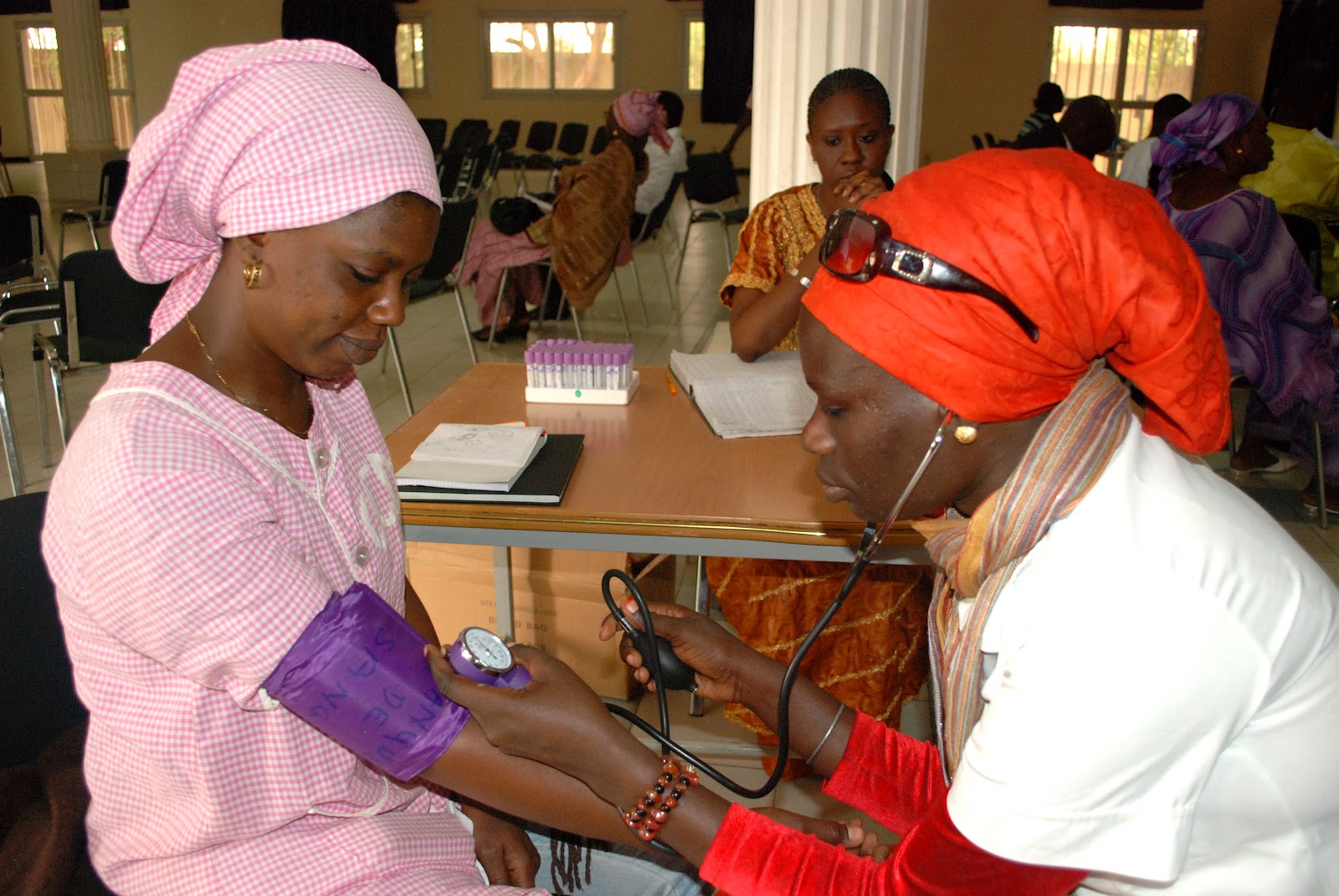
Aminata Saho, a Tostan team member at the CCDD, has her blood pressure taken. She and her friend and colleague, Ndiaye Aminata Puit, learned about the blood drive that day and both decided to donate for the first time.

**
Ardo Fall, Director of the CCDD, watches as his donation bag fills. He has given blood for four years and often travels to the hospital to give for emergency cases. When asked why he gives blood, Ardo responded, “Because it saves lives. It’s something that I respect because some day, it might be me who needs it.”

**
Smiling, Aminata stays calm during her first blood donation. She shared that she wanted to donate because giving blood can help people who are sick, such as her mother who recently received a blood transfusion. 

**
Khady Diato Sall, the donation organizer at the blood bank in Thiès, Senegal has given blood over 50 times. “[Donating blood] is a civic act,” Khady explained. “Many people don’t do it because they are afraid or they think it won’t help. But every day the hospital calls us for donations. It saves lives.”

**
Ousamane Cisso used to be afraid to give blood, but has since overcome his fear and encouraged many of his friends to donate as well. His mother works for the blood bank, and Ousamane and many of his relatives came to the CCDD to donate on the day of the blood drive.

**
Mohamed Sall (far left), Ousamane Cisso’s cousin, came to give blood for the first time. He used to be afraid of needles, but Ousamane encouraged him to overcome his fear. “I know the hospitals suffer from a lack of blood. I wanted to help people because it can save a life,” explained Mohamed. Here he poses with his friends.

**
The Cisso family after giving blood. From left to right: Ismael Cisso, Allasane Cisso, Mamie Cisso, Aliou Cisso, Boubacar Cisso.

**
Ndiaye Aminata Puit (right) poses with her friend, Sorde, after donating for the first time. 

** 
Khady Guèye (left), Treasurer of the Federation of Community Management Committees (CMC) in the region of Thiès, and Khady Mbaye Ka (right), President of the Thiès CMC Federationalso gave blood for the first time. Khady Mbaye explained, “Giving blood is a noble act. A way to manufacture blood has not yet been invented so we will always need donations.” She continued that many women, including one of her sisters, need blood transfusions during childbirth due to haemorrhaging.


Tuesday, February 21, 2012

VOICES OF TOSTAN: Nafissatou Sabaly

Tostan Facilitator Nafissatou Sabaly sparked discussion both within her family, her native village, and throughout the social network linking the village of Néma Dianfo to neighboring communities in Senegal. These discussions catalyzed a major shift in community-wide opinion of the practices of female genital cutting (FGC) and child/forced marriage. In an interview with Will Schomburg, Tostan Communications Assistant in Dakar, Nafissatou describes her personal journey.


Nafissatou Sabaly, Tostan Community
Empowerment Program Facilitator
in Néma Dianfo, Senegal 
How does your family feel about your work?

I grew up in Yirkoye [a village in Senegal]. Since I started at Tostan, I’ve talked with my mother, my grandmother, my sisters and my brother about FGC. My mother told us that we had to [practice FGC]; that it was our custom. But when I told her, “No, it’s something that can kill,” she really started to think about it. We didn’t know the risks when I was a child. But now my brother’s daughters have never been cut—when he started having children, I took the time to talk with him about it.

Did all of your family agree with his decision?

My father didn’t have a problem with ending the practice. He pushed my mother to give it up. He understood the dangers right away when I explained them. But my mother kept asking if her granddaughters would be able to find a husband if they weren’t cut.

How did other community members respond to your views on FGC?

It was difficult to convince my home village. But every time I went back to visit, I talked with the women in my family, and especially with my brother’s wives. And they came and stayed and listened.

How did you convince them?

There’s one woman in my village who has never been able to have a child because she was cut. I explained why she couldn’t carry a child, and that really scared the women. And one of my brother’s wives had been cut when she was younger. They married when she was 14 years old and she had to have a cesarean. She was sick in the hospital for an entire month.

How did you feel about your brother marrying someone so young?

I objected. The girl didn’t know she had a choice. Her parents chose for her. After she ended up in the hospital and my brother saw what had gone wrong, he said he would never let his own daughters marry so young.

How did the rest of your family react?

Everybody saw what had gone wrong. My younger sister is 22 years old now, and my parents haven’t made her marry.

Do you think your family will continue to support her decision?

I was married when I was 17 years old, in 1990. I divorced in 1999. [My husband] wasn’t terribly cruel, but we weren’t getting along and there was occasional violence. My father thought I just didn’t want to be married. He said, “Sometimes there’s just violence in a marriage. It’s like that.” I told him: “You took me out of school to get married, now I’m moving back home and I’m going to start school again.” And I did—I found an organization, [Tostan], where I learned to read and write in Pulaar.

Now my father understands better. Every time he wants to marry my sister off, I say, “Don’t forget what happened to me. Don’t forget what happened to [my brother’s wife].” And he’ll say, “That’s right, I remember.”

Wednesday, February 15, 2012

ANNOUNCEMENT: Molly Melching to Speak at FGC Abandonment Event with U.S. Secretary of State Hillary Rodham Clinton on Feb 16


Holding a banner that reads, "We can fully abandon FGC
 in Senegal," Tostan CEP participants proudly marched
 to a public declarationfor FGC abandonment in May 2011.

Invited by U.S. Secretary of State Hillary Rodham Clinton, Tostan Founder Molly Melching will speak at a high-level panel discussion commemorating International FGC Abandonment Day this Thursday, February 16th, at the U.S. Department of State.

The event will be hosted by Secretary Clinton and moderated by Ambassador Melanne Verveer, Ambassador-at-Large for Global Women's Issues. The panel will also feature Imam Magid, All Dulles Area Muslim Society (ADAMS Center), Thomas von der Osten-Sacken, General Manager for Crisis Assistance and Development Co-operation (WADI) in Germany, Nafissatou J. Diop, Director of the United Nations Population Fund and United Nations International Children’s Fund Joint Programme on FGM/C, and Zeinab Eyega, Executive Director of the Sauti Yetu Center for African Women. 

Follow @Tostan on Twitter for live updates from the event beginning at 1:00pm EST on the 16th. Also, live streaming of the event is available here.   

For additional information, click here to see the official event announcement.   

 
Blog adapted by Salim Drame