Friday, July 20, 2012

VOICES OF TOSTAN: Stephen Allen

An organization is nothing without the passion and dedication of the team of individuals behind it. Tostan is comprised of talented, committed people ranging from village elders to directors, Community Empowerment Program facilitators and participants to volunteers and interns. Each individual contributes his or her unique personality and skills to further the work of Tostan, thus creating a dynamic environment in which positive change can take place.

We highlight the diversity of interests, talents, and backgrounds within the Tostan team here on the blog in a series entitled Voices of Tostan. Specifically, we will explore what brought each unique voice to Tostan and why Tostan’s efforts to bring about positive social change are significant and meaningful to each individual.

Story by Stephen Allen, MERL Volunteer, Thiès, Senegal

Stephen (bottom right in green) with members of the MERL team, supervisors, and a facilitator.

Arriving in Senegal the first week of June to begin one year of volunteering with Tostan, I was eager to begin my work in the Monitoring, Research, Evaluation, and Learning (MERL) Department in the Senegal National Coordination in Thiès. 

As the name indicates, the MERL Department is responsible for designing data collection tools and carrying out monitoring and evaluations in the communities where Tostan projects are implemented. Tostan uses these reports to feed back to donors, to tell the stories of Tostan’s work from the field and for Tostan’s own continuous improvement of its programs. The MERL Department is able to accomplish its mission partly through organizing field missions to communities at key phases of project implementation in order to complete surveys and monitoring reports. 

When, during my second week, I received the news that I would be accompanying one such mission to ten communities, I was delighted to be able to accompany a field mission so early on in my time in Senegal. 

Bag packed, I headed out with the MERL team to the regions of Kaolack and Kaffrine, just north of The Gambia, for a twelve-day, ten-community final evaluation mission. 

The communities that participated in the evaluation were Pulaar, an ethnic group that represents a minority in every country in which they live but which extends from West Africa all the way to Chad and parts of Sudan. Having just completed Tostan’s Community Empowerment Program (CEP)—a three-year participatory education program that teaches hygiene, health, literacy, and project management, all with a focus on human rights—the ten communities were eager to share their successes with the MERL team. At Néty Dagga, participants from the adolescent Tostan class could be heard all morning reciting Pulaar songs that their facilitator had taught them to help learn the steps of conflict resolution. While at Galoulé, the women insisted we look at the soaps they had produced themselves for sale as an income-generating activity, using their newly acquired management skills. 

Children and adolescent participants in the village of Médina Torodo perform a song.

Tostan regional supervisors, themselves of Pulaar origin, carried out the surveys and interviews for the evaluations conducted in each village. I had the opportunity to sit in on interviews with each village’s Community Management Committee (CMC). A CMC is a seventeen-member, democratically selected committee that is put in place when a community is implementing Tostan’s CEP. The committee is charged with putting the skills acquired through the Tostan program into practice by encouraging active community involvement through democratic participation and long-term sustainable development

Being able to see in person what the other new volunteers and I had just discussed during our volunteer orientation was extraordinary.  I met so many CMC members who were so committed to the development of their communities.  
Over those twelve days, I was able to learn an incredible amount about the Monitoring and Evaluation Department, Tostan’s Community Empowerment Program (CEP), monitoring and evaluation techniques, and the Pulaar people’s wonderful history and traditions. 

My personal observations from the field have been indispensible in helping me to write reports for the evaluation. In all, I had an amazing and educational two weeks—what a way to begin my year with Tostan! 


Wednesday, July 18, 2012

Melinda Gates Visits Empowered Community Members in Senegal


Molly Melching, Tostan Executive Director, explains to Melinda Gates how Tostan teaches cell phones with the metaphor of a mango tree.

On Sunday 8th July, the community of Kolma Peulh warmly welcomed a special visitor.

Melinda Gates of the
Bill & Melinda Gates Foundation visited this small rural village in the Kaolack region of Senegal, West Africa on her way to London where she opened the Family Planning Summit 2012.

Ms. Gates spent three hours with women, men, and children of Kolma Peulh discussing the impact that empowering basic education can have on improving women’s health, particularly in the areas of family planning, female genital cutting(FGC), and child/forced marriage.

Throughout the visit, women confidently spoke out about these formerly taboo issues and explained how they had negotiated deep social change with their husbands, religious leaders, and neighboring communities, creating a broad consensus to end practices harmful to their health and that of their children. Community members from Kolma Peulh and neighboring villages are participating in the Tostan Community Empowerment Program (CEP), a three-year non-formal education program in national languages developed for those who have little or no access to formal schooling.

Ms. Gates was particularly interested in learning how social norms affect communities’ attitudes and behaviors and how the CEP provides a holistic framework for all community members to address issues on their own terms.

One man commented that when he learned about the negative consequences of women having children year after year he was keen to begin birth spacing in his own family. "Before we were nearsighted. Nearsightedness of the eyes is bad, but nearsightedness of the heart is worse. We have now adopted practices that we know will lead to better health for women and children in the community and have ended practices that don’t. In the past, we felt we could never question traditional beliefs and didn’t have the right information and social support to change."


Tostan Executive Director Molly Melching noted that the visit was well received by all involved.  “Tostan’s work is community-led and all of us at Tostan were thrilled that the people of Kolma Peulh had the opportunity to share their accomplishments, passion, and vision for the future with Ms. Gates, directly through an extended, open dialogue."

Friday, July 6, 2012

Discussing the Abandonment of FGC and Child/forced Marriage in Kolda

Story and photographs by Angela Rowe, Tostan Regional Volunteer in Kolda, Senegal

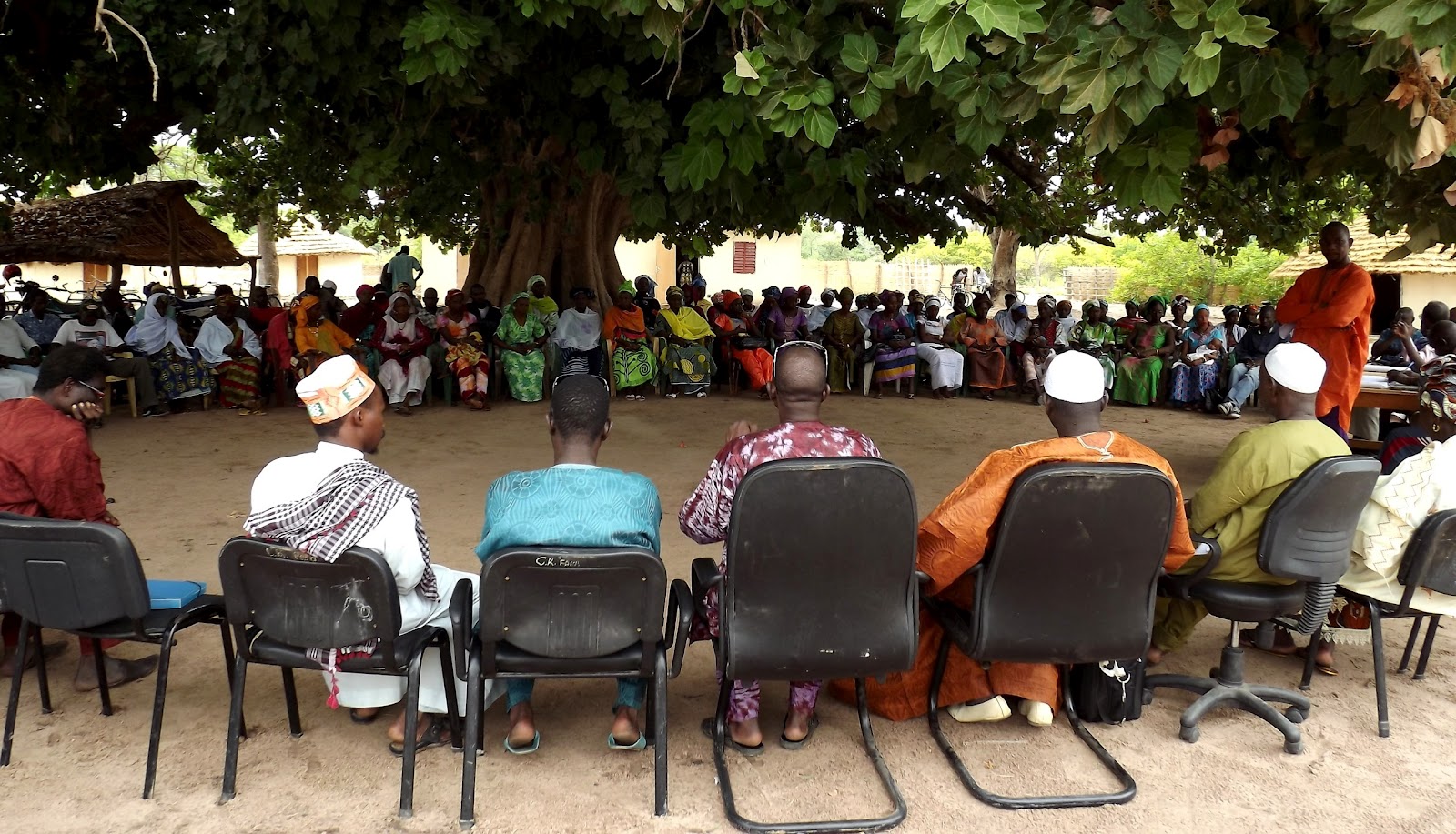
Participants at the two-day Tostan workshop in Fafacouru.
Sixty villages in southern Senegal have just completed Tostan’s Community Empowerment Program (CEP).  The villages in the department of Medina Yoro Foulah have spent the last three years working with Tostan to increase literacy and local engagement in projects centered on education, health, hygiene, human rights, and democracy.

Topics such as female genital cutting (FGC) and child/forced marriage are discussed at the community level through participation in the program.

A woman participant works with her
group to generate ideas for handling
violence at the community level.
On June 25th and 26th, Tostan held a two-day workshop in Fafacouru to discuss human rights and democracy and community-led initiatives to end FGC and child/forced marriage.  This workshop was attended by over 150 people, including Tostan staff, program participants from eight different villages, Community Management Committee (CMC) members, NGO partners, and other local leaders.


The workshop began with Mamoudou Camara, Assistant Coordinator of Tostan Kolda, asking the participants to share their expectations for the workshop.  Together the community discussed their desire to further understand Tostan’s strategy and program, to discuss the importance of human rights in regards to both positive and negative social norms, and finally, to generate a sense of community involvement for the abandonment of FGC.  The workshop consisted of presentations regarding Tostan’s values and mission, program implementation and subsequent results. Participants were encouraged to ask questions and share their thoughts with the group, several of whom cited Tostan’s CEP as being an essential component to creating positive social change in their own communities.

One inspiring part of the workshop was when a Tostan presentation on human rights prompted a lively and impassioned dialogue among the participants.  In small groups, community members discussed the types of violence and discrimination they had personally witnessed or experienced, and subsequently generated ideas of how to handle these situations should they arise again in the future.  The recognition of basic human rights, they concluded, was the first step in confronting negative social norms.  After sharing and presentation sessions, the conversation naturally unfolded into a reflection on one of the most sensitive community issues: FGC.

Imam of Fafacouru speaks out
about the harmful consequences of FGC.
FGC, a practice once viewed by many to be an essential piece of traditional culture, can result in higher rates of maternal and infant mortality, fistulas, and other serious health problems for girls and women. After three years of non-formal education, participants were able to participate in open dialogue about these issues and come to a decision together around the necessity to abandon the practice.

At the end of the workshop, Tostan was asked to further extend their program into surrounding villages.  The department of Medina Yoro Foulah hopes that through the process, all its villages will soon declare total abandonment of both FGC and child/forced marriage.

Though the education about human rights through Tostan’s CEP was certainly a catalyst for change, as demonstrated through the workshop and by people coming together to discuss these issues, the most powerful and sustainable forms of social change come from the communities themselves.


Monday, June 25, 2012

Outstanding Supporter: Spreading Awareness through Artwork


Story by Kate Brendel, Tostan Development Assistant in Washington, DC

Musician and long-time Tostan supporter, Karien de Waal, used her artistic talents to creatively raise awareness and support for Tostan’s mission. By means of a year-long art project that collected the faces and signatures of numerous celebrities, Karien hopes to not only raise money to support Tostan’s programs, but also to get her community as excited about Tostan’s work as she is.

The Women of the World displaying Karien's drawing.
Based out of Berklee College of Music in Boston, Massachusetts, Karien has had many opportunities to interact with world-renowned musicians who regularly come to her school to perform.  Hoping to do something to garner support for Tostan within her community, she began drawing these celebrities as they visited the Berklee campus and had them autograph her canvas. “The idea was to get as many famous people to sign on one canvas as possible,” said Karien. Signatures on Karien’s canvas include such musicians as Chucho Valdes, John Mayer, Emilio and Gloria Estefan, India Arie, The Eagles, and many more.

Taking her outreach one step further, Karien contacted many of the musicians she had drawn to tell them about her project and about Tostan’s work. “I decided that for each celebrity that I drew, I would write them a letter to tell them about [female genital cutting] FGC and the positive work Tostan does through education. I kept it in the tone of your organization, focusing on the solution, rather than the problem.”

Chucho Valdes adding his signature to the canvas.
Now that her masterpiece is complete, Karien’s goal is for this canvas to be auctioned off, with the proceeds directly benefiting Tostan.

In addition to creating the drawing, Karien also hosted an art exhibit at a local coffee shop, Pavement. Confident that this exhibit would gain lots of attention, she created a poster and distributed media materials, including an introductory video about Tostan. “Pavement is the most popular coffee shop on the block and I wouldn't be surprised if around 4,000 customers go through there a week.” At the end of the three-day exhibit, all 50 copies of the DVD had been taken, and word of Karien’s mission was quickly spreading throughout the community.

Although her canvas is finished, Karien’s mission to spread awareness of Tostan is certainly not over. She has numerous plans for future projects that will incorporate her many talents as a musician, artist, and community supporter. “I can get people to buy into the cause to make a positive change,” explained Karien, “because I truly believe in your work.”

Karien's artwork will be auctioned off to benefit Tostan. To find out more information, contact Elizabeth at info@tostan.org.


Blog adapted by Salim Drame